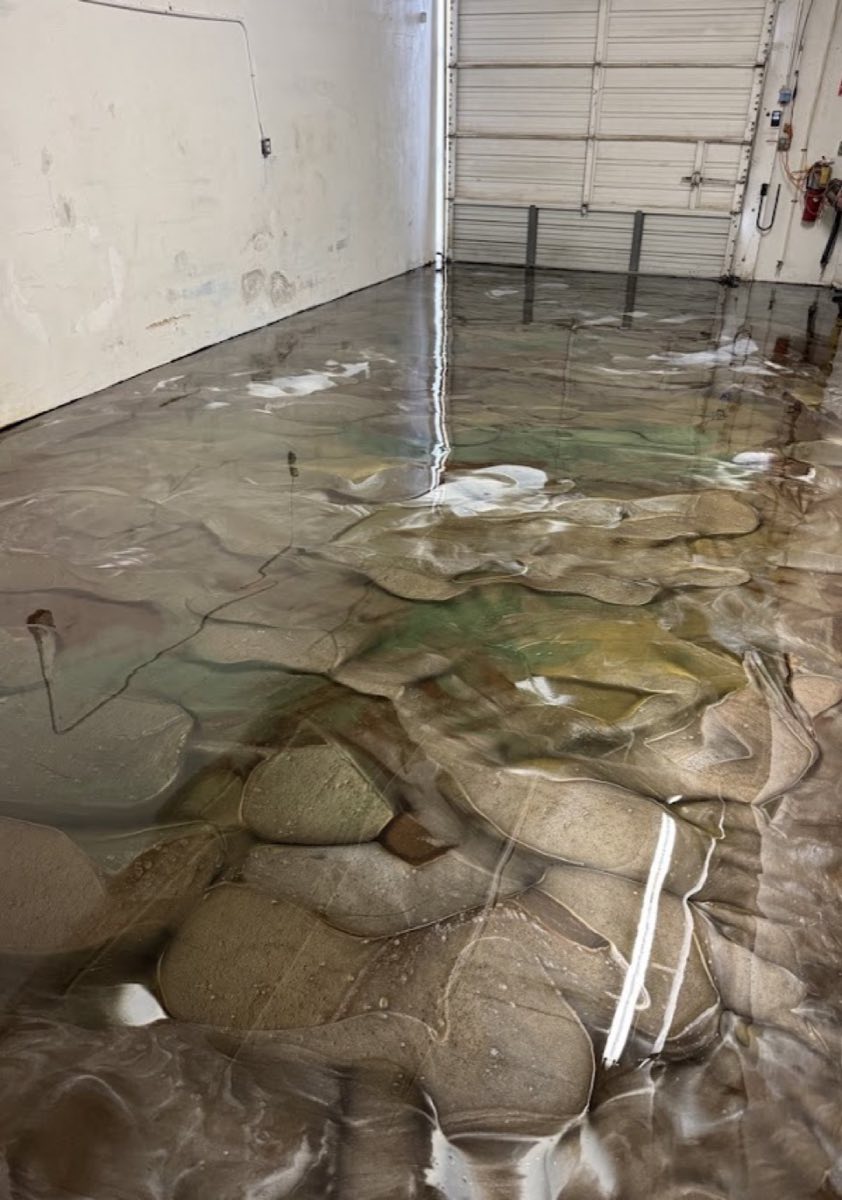
Flake epoxy is durable, hides wear and slab flaws, adds slip resistance, and costs less, ideal for working garages. Metallic epoxy is a hand-troweled, stone-like statement floor, ideal for showrooms, gyms, and indoor living spaces. Both get a polyaspartic topcoat.
What Flake Epoxy Is Best At
Flake epoxy broadcasts decorative vinyl chips into the base coat, then locks them under a clear topcoat. The result is a textured, speckled floor that hides dirt, patch lines, and the surface variation common in older Miami slabs.
It is the workhorse finish: slip-resistant underfoot, forgiving of wear, and available in 30-plus color blends. For a garage that actually gets used, flake is usually the smart pick.
What Metallic Epoxy Is Best At
Metallic epoxy uses pigmented resin hand-troweled to create movement, depth, and a polished-stone or liquid-marble look. No two floors are the same. It reads as a design feature, not a garage coating.
It shines in spaces people see: showroom-style garages, home gyms, sunrooms, and indoor living areas. In a Miami home with warm Mediterranean interiors, a copper or bronze metallic floor can look like natural stone.
Durability and Maintenance
Both finishes are tough when topped with polyaspartic. Flake’s texture hides scuffs and adds grip, which is handy in a wet-prone climate. Metallic is smoother and shows less forgiveness for heavy abuse, so it is better suited to lower-traffic, high-visibility rooms.
Cleaning is easy for both: dust mop and the occasional damp mop. Neither needs waxing.
Cost Difference
Flake systems generally run less per square foot because the install is more repeatable. Metallic costs more because it is artistic and labor-intensive. If budget is the deciding factor and the space is a working garage, flake gives you more floor for the money.
If the floor is a feature you want guests to notice, metallic earns its premium.
Flake Sizes and Blends: the Decisions Inside the Decision
Choosing flake is not the end of the choices. Chip size changes the character completely: quarter-inch flake reads as a uniform, almost granite-like texture from standing height, while one-inch chip is bolder and more terrazzo-like. Full broadcast, where chips cover every inch, hides the most and wears the best; partial broadcast lets the base color show through for a quieter look.
Blends are where Miami homes get personal. Greys with a blue or teal cast read coastal and pair with white garage cabinetry; earth-tone blends warm up Mediterranean houses; high-contrast black-and-white suits modern builds. We carry physical samples of the blends we install most, because chip colors on a phone screen lie.
How Metallic Floors Are Actually Made
A metallic floor is poured, not painted. Metallic pigment is mixed into clear epoxy, and the installer moves it with trowels, rollers, even air, while it is wet, creating the drifts and veins that make the floor look like polished stone or slow-moving water. Gravity and viscosity finish the job as the resin self-levels, which is why no two metallic floors can ever match exactly.
That improvisational quality is the appeal and the risk. An experienced installer guides the movement toward the look you agreed on, a copper floor with bronze veining, a charcoal floor with silver smoke. An inexperienced one produces mud. This is the system where the portfolio matters most, and ours came from a decade of finishing marble before we ever poured a metallic.
Seeing Both in a Real Space Before You Commit
Photos compress the thing that makes these floors different: depth. Flake reads as texture, metallic reads as movement, and neither does it justice on a screen. We bring cured sample panels to every walkthrough so you can put them on your actual slab, under your actual lighting, next to your actual walls.
Lighting changes everything. A metallic that glows under showroom LEDs can look flat under a single garage bulb; a flake blend that looks busy in sunlight calms down indoors. Five minutes with panels in the real room settles what an hour of scrolling cannot. Call (786) 488-5057 and we will bring the samples.
What Each Floor Asks of You Over Ten Years
A flake floor’s decade is boring, which is the point. The texture hides the scuffs, the chips disguise the dust between cleanings, and the polyaspartic top keeps the color stable through years of open-door sun. Around year eight to twelve of hard use, a single topcoat refresh, one day of work, resets the wear surface without touching the decorative layer.
A metallic floor’s decade depends on where it lives. In a showpiece garage or indoor space it ages like furniture: keep grit off it with a soft broom, lift rather than drag, and the depth stays liquid for many years. In a hard-working garage it will collect fine scratching in the clear coat that a matte floor would hide, which is why we steer working garages toward flake in the first place.
Neither floor wants wax, polish, or anything from the tile aisle, and both clean with water and a neutral soap. The ten-year cost difference between them is almost entirely the install-day price gap; the maintenance lives are nearly identical when each is in the room it belongs in.
The Resale Conversation
Realtors in Miami-Dade will tell you a finished garage floor photographs better than almost any equivalent spend in the house, because the listing photo of a clean, coated garage signals a maintained home. Flake reads as practical quality to the widest pool of buyers; metallic reads as a custom upgrade and can anchor the ‘finished bonus space’ framing for a gym or studio conversion.
Neither is a renovation you do for resale alone, you do it to stop living with a dusty slab. But if a sale is on the horizon, flake in a working garage is the neutral crowd-pleaser, and metallic belongs where the buyer will read it as designed space rather than personalization they would have to undo.
How to Decide
Ask what the room is for. Working garage, kids, pets, beach gear: flake. Showpiece space, gym, indoor conversion, design statement: metallic. Still unsure? We bring sample panels to the walkthrough so you can see both against your space.
Book a walkthrough and we’ll lay the options on your actual floor. Call (786) 488-5057.
Finishes FAQ
Which is more slip-resistant?
Flake. Its texture adds grip, which matters in a humid, wet-prone climate. Metallic is smoother, though an anti-slip additive can be added to either topcoat.
Is metallic too fancy for a garage?
Not at all. Showroom-style garages are a top metallic request. It depends on whether you want the garage to look like a feature space.
Do both resist Florida heat?
Yes, when topped with a UV-stable polyaspartic coat. That topcoat is standard on every floor we install.
Can I see samples first?
Yes. We bring physical sample panels to the free walkthrough so you can hold flake and metallic against your tile and walls.
Which is easier to clean?
Both are low-maintenance: dust mop and occasional damp mop, no waxing. Flake hides dust slightly better between cleanings.
Can you mix flake and metallic in one space?
Yes, and it works well: metallic in the showpiece zone, flake in the working zone, with a clean transition line. Gyms with a metallic lifting platform and flake field are a favorite.
Do flake or metallic floors fade in Florida sun?
Not under a polyaspartic topcoat, which is UV-stable and holds clarity where bare epoxy ambers. Vinyl flake pigments are themselves colorfast, and metallic pigments are mineral-based. The fade risk in Florida lives entirely in the clear coat chemistry, which is exactly why we never finish a floor without the polyaspartic layer.
Got a slab? Let’s pour it right.
Photo plus square footage equals a real quote in 24 hours. Serving Miami-Dade, Broward, and Palm Beach.
Resurface My Floor → Call (786) 488-5057