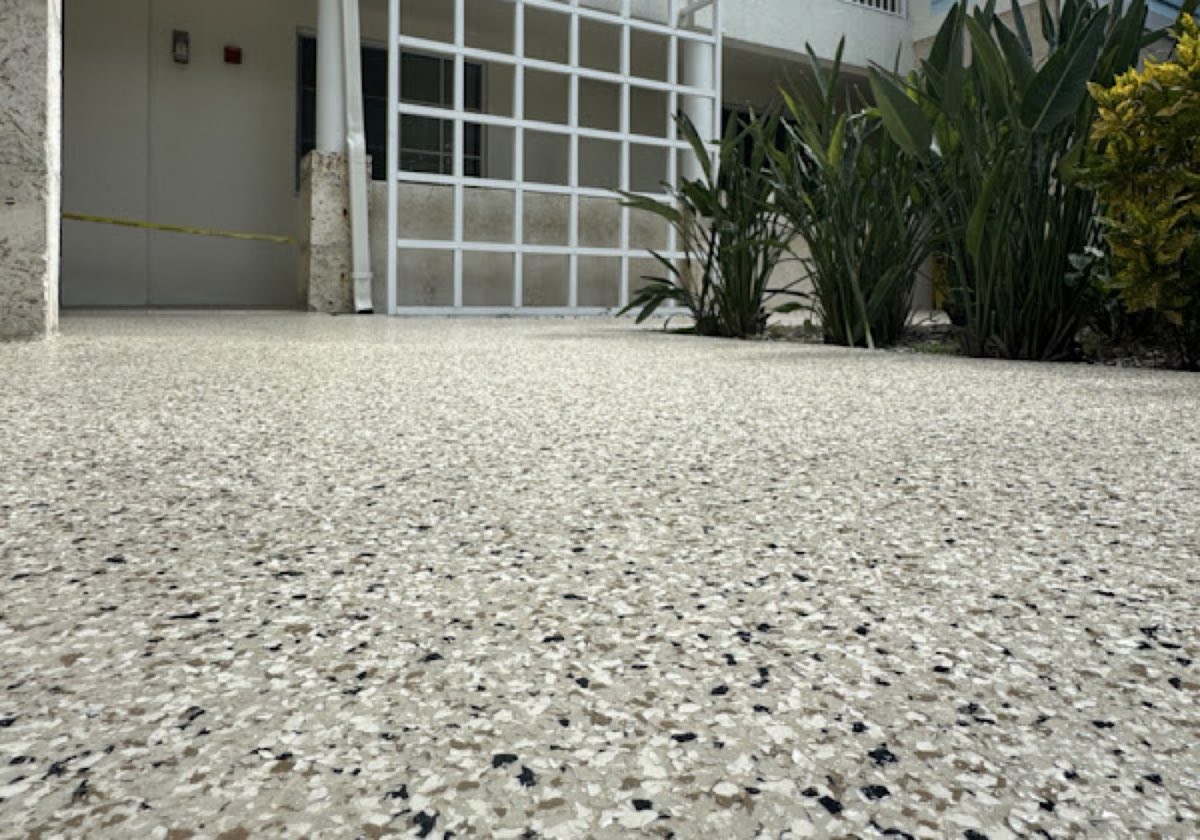
Salt air and high humidity drive corrosion and coating failure on coastal slabs. The defenses are a diamond-ground bond, moisture mitigation where needed, and a UV-stable polyaspartic topcoat that seals out salt and water. Waterfront properties need this more than anyone.
What Coastal Exposure Does to Concrete
Concrete near Biscayne Bay lives in a corrosive bath of salt and moisture. Salt accelerates the rusting of any embedded steel, and constant humidity keeps slabs damp far longer than inland floors. Together they break down uncoated and poorly coated surfaces fast.
Garages, balconies, pool decks, and cabana slabs on waterfront lots all take this abuse, often while looking fine until the damage is well underway.
Why Standard Coatings Fail Here
A weekend epoxy kit has no real defense against salt-driven moisture. It bonds weakly, lets vapor through, and ambers under UV. On the coast it can fail in a single season.
Protection requires a system designed for moisture and sun, not a single thin coat of resin.
The Coastal-Grade System
We start with diamond grinding for a strong mechanical bond, then moisture-test and add a vapor-mitigation primer if the slab reads high. The base coat builds the body, and a UV-stable polyaspartic topcoat seals out salt and water while holding color in full sun.
That stack is what stands up to coastal conditions. Each layer has a job and we don’t skip any of them to compete on price.
Protecting Outdoor and Transition Spaces
Pool decks, walkways, patios, and cabana floors near the water benefit from flake or quartz systems with aggressive anti-slip grit, since they are wet often. Lighter colors stay cooler underfoot in the sun.
Sealing these transition spaces also keeps salt and water from migrating into adjacent garages and interiors.
How Far Inland Does Salt Reach?
The brutal zone is the first few blocks from open water, where airborne salt physically settles on every horizontal surface daily. But measurable chloride exposure rides the sea breeze well past the waterfront, across most of Miami Beach, Key Biscayne, Edgewater, and the bayfront corridors. If you can sometimes smell the ocean from your driveway, your concrete is in the exposure map.
Elevation and orientation matter as much as distance. A west-facing garage tucked behind a building takes a fraction of the load of an east-facing slab catching the onshore breeze. It is why we walk a property instead of quoting coastal work off a zip code.
The Chloride Mechanism, Briefly and Honestly
Chloride ions are small enough to migrate through concrete’s pore network, and they are corrosion catalysts: they break down the passive oxide layer that normally protects embedded rebar. Once that layer fails, the steel rusts, rust occupies several times the volume of the steel it came from, and the expansion cracks the slab from inside. That is spalling, and by the time it is visible the chemistry is years along.
This is why coastal protection is about sealing the pore network early, not patching the surface late. A bonded coating system interrupts the chloride path entirely, and on the coast that is the whole game.
A Seasonal Rhythm for Waterfront Slabs
Coastal concrete does best on a calendar. After storm season, rinse coated surfaces and check drains, storms throw the year’s biggest salt loads. In the dry winter, walk the property once: look for coating chips, hairlines at slab edges, rust tracks below balcony lips. Spring is the window to schedule repairs and topcoat refreshes before the summer humidity arrives.
None of it is laborious, a hose, an hour, and a phone call when something looks off. The waterfront properties that age well are not lucky, they are rinsed and resealed on schedule. Want a once-over before storm season? Call (786) 488-5057.
Garages, Sea Breeze, and the Cars That Bring Salt Home
Waterfront garages take a double exposure most owners never think about. The sea breeze delivers airborne salt through every open-door hour, and the cars deliver it by the wheel-well: beach parking, causeway spray, and rinsed-off boat gear all drip brine onto the same slab, every day, in the same spots. An uncoated garage floor two blocks from the bay is salt-curing like a ham.
The fix is the same coastal-grade stack, with two emphases: a full-height coved or sealed edge where slab meets walls, so brine cannot wick into the joint, and a topcoat specified for chemical resistance, because salt water is chemistry, not just water. Lighter flake blends also make salt residue visible so it gets rinsed instead of ground in underfoot.
If you store a boat, a flats skiff, or dive gear in the garage, tell us at the walkthrough. Wash-down habits change the spec: we will position the slope and pick the texture so that hosing the floor toward the door is a thirty-second job instead of a squeegee workout.
New Waterfront Construction: Seal Before the Damage Starts
The cheapest coastal floor we ever protect is the one in a brand-new building. A new slab two blocks from the bay has clean pores, no chloride load, and full design strength, coating or sealing it in year one locks that state in. Developers and new owners who protect floors at move-in skip the entire degradation arc this article describes.
If you are closing on new waterfront construction, put the garage and any exposed slabs on the punch-list conversation. The builder’s broom-finish concrete is a starting point, not a finished surface, and the gap between sealing it now and restoring it in year ten is measured in multiples, not percentages.
Maintenance That Extends Life
Rinse salt off coated outdoor surfaces periodically, especially after storms, and keep drains clear so water doesn’t pond. A topcoat refresh every several years renews the seal without redoing the system.
If you own near the water, your slabs are working harder than most. Call (786) 488-5057 for a coastal floor assessment.
Coastal FAQ
Does salt air really damage concrete floors?
Yes. Salt accelerates corrosion of embedded steel and humidity keeps slabs damp, breaking down weak coatings quickly on coastal properties.
What coating holds up near the water?
A diamond-ground system with moisture mitigation as needed and a UV-stable polyaspartic topcoat that seals out salt and water.
Can you coat my pool deck and patio?
Yes. Outdoor and transition spaces get flake or quartz systems with anti-slip grit and lighter, cooler colors.
How often should a coastal floor be refreshed?
A topcoat refresh every several years renews the seal. Rinse salt off and keep drains clear between refreshes.
Is waterfront moisture mitigation expensive?
Only if the slab tests high, and it is far cheaper than a floor that fails from vapor pressure. We always test first.
Does pressure washing help or hurt coastal concrete?
A moderate rinse helps by removing settled salt. High-pressure tips held close can wound weak coatings and force water into hairlines, so wash gently and let the coating do its job.
Is there a coating that stops existing rebar corrosion?
A surface coating stops new chloride and moisture from entering, which slows active corrosion dramatically, but it cannot reverse rust already expanding inside the slab. Visible spalling needs concrete repair first, corroded steel treated, sections rebuilt, then the coating seals the repaired slab. That order is non-negotiable, and we scope both phases honestly.
Do pavers and driveways near the bay need different treatment than slabs?
Pavers want a penetrating or film-forming sealer matched to their clay or concrete body, while poured slabs take the full coating stack. Both benefit from the same rinse-and-reseal rhythm. We treat them as one scope on waterfront properties so every horizontal surface ages on the same schedule.
Got a slab? Let’s pour it right.
Photo plus square footage equals a real quote in 24 hours. Serving Miami-Dade, Broward, and Palm Beach.
Resurface My Floor → Call (786) 488-5057