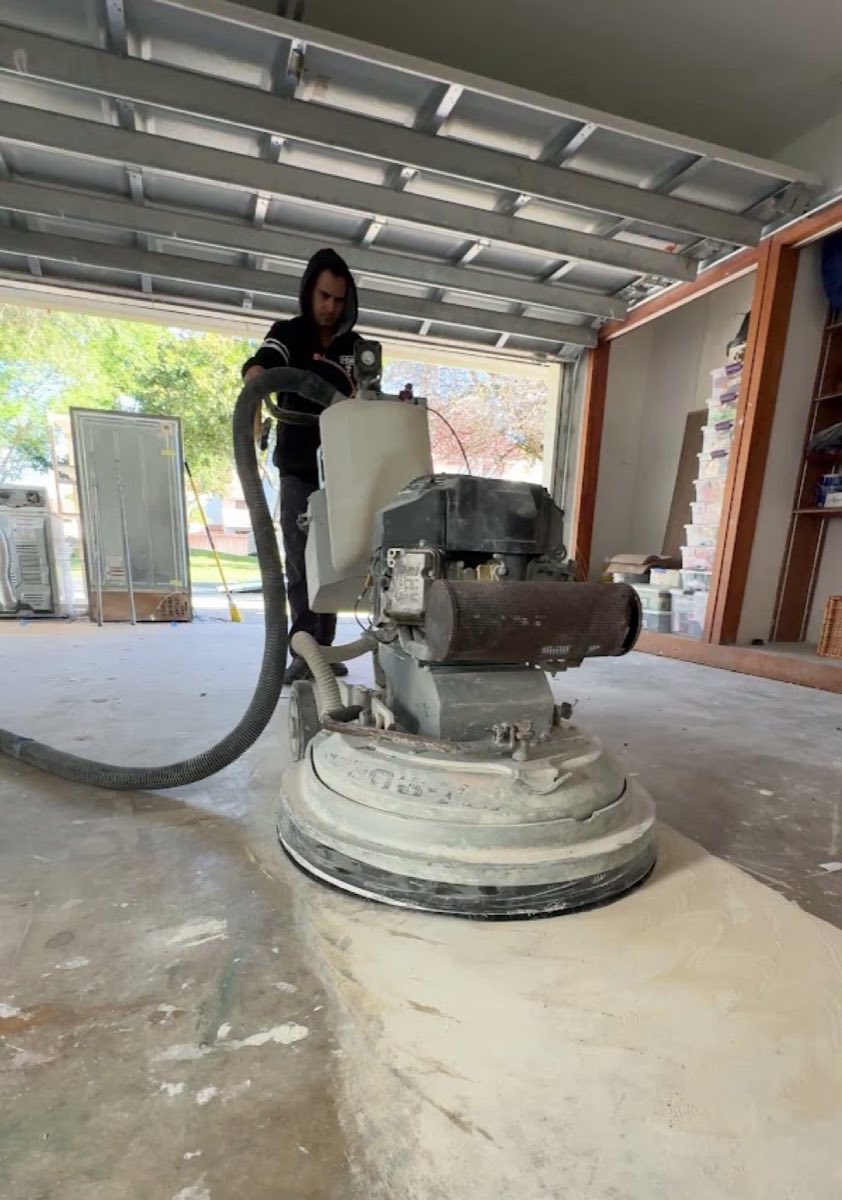
Miami garage floors peel because of three things: big-box water-based epoxy that can’t take UV, acid-etch prep instead of diamond grinding, and heat-driven moisture pushing up through the slab. A diamond-ground floor with a UV-stable polyaspartic topcoat solves all three and lasts 10 to 15+ years.
It Is Almost Never the Epoxy Itself
When a garage floor peels in South Florida, homeowners blame the epoxy. The real cause is usually the prep underneath it and the topcoat over it. Epoxy is a strong base layer, but on its own it yellows and chalks under direct UV, and Miami garages take a brutal amount of sun and heat.
We have ground out floors that failed in under 18 months, and the pattern is the same every time: a thin acid-etched bond, a water-based kit from a hardware store, and no UV-stable topcoat. The product wasn’t built for this climate.
The UV and Heat Problem
Standard epoxy is not UV-stable. In a closed garage that might be fine, but most Miami garages have open doors, glass panels, or west-facing exposure that bakes the floor every afternoon. The resin ambers, then gets brittle, then lets go at the edges first.
Polyaspartic and polyurea topcoats are engineered to hold color and flex under UV and temperature swings. That’s why every floor we install gets a polyaspartic wear coat over the epoxy or flake base, not a second coat of the same epoxy.
Moisture Coming Up Through the Slab
South Florida sits on a high water table. Heat drives ground moisture up as vapor, and that vapor pressure delaminates any coating that wasn’t bonded into a properly profiled surface. This is why a floor can look perfect for a year, then bubble in a single hot week.
We moisture-test every slab before we quote. If a floor reads high, we adjust the primer system, because installing over an untested slab in Miami is how you guarantee a callback.
Why Diamond Grinding Beats Acid Etching
Acid etching is the fast, cheap prep most peeling floors started with. It opens the surface unevenly and leaves residue that weakens the bond. Diamond grinding mechanically profiles the concrete to a consistent CSP 2-3 texture so the coating locks in.
Prep is roughly half the job and all of the difference between a 2-year floor and a 12-year floor. We grind every slab, chase and fill cracks, and vacuum twice before primer touches the floor.
How to Read a Peeling Floor Like an Installer
Where a floor lets go tells you why it let go. Peeling that starts at the garage door line is UV and heat: the sun loads that strip every afternoon and a non-stable resin gives up there first. Bubbles and blisters scattered across the middle of the slab are vapor pressure, moisture from below pushing the coating off like a sticker. Sheets lifting cleanly with bare, smooth concrete underneath mean the prep never opened the surface at all, the coating was sitting on the slab instead of bonded into it.
Edge chipping around cracks and control joints is its own category. Coatings bridge joints badly unless the joints are honored or filled correctly, and South Florida slabs move more than people think as heat cycles through the day. We map all of this in the first ten minutes of a walkthrough, and it usually tells us the whole history of the floor.
The Hot-Tire Myth, and What Is Actually Happening
Hot tire pickup gets blamed for half the peeled garage floors in Miami, as if tires were somehow dissolving the coating. What actually happens is simpler: a marginal bond plus heat. Tires come off I-95 at well over 150 degrees, park on the same two strips every day, and that heat cycling works the weak bond loose. The coating fails where the tires sit because that is where the stress is, not because rubber is special.
A diamond-ground floor with a quality base coat and a polyaspartic top simply does not hot-tire. The bond is mechanical, into the profile of the concrete itself, and the topcoat is built to flex through the heat cycle. We park our own trucks on our own floors. If hot tires defeated proper installs, we would have gone out of business years ago.
What the Redo Actually Involves
If your floor has already failed, the path back is straightforward but not skippable. The failed coating comes off completely with PCD-tooled grinders, every last flake of it, because new coating over old failure inherits the old failure. Then the slab gets moisture-tested, because the original installer almost certainly never did, and the reading decides whether a standard primer or an epoxy vapor barrier goes down first.
From bare, profiled, tested concrete, the rebuild is the same system we install on new slabs: primer matched to the moisture reading, base coat, decorative layer if you want flake or metallic, and the polyaspartic wear coat. The redo costs more than the original cheap floor did, which is exactly the argument for doing it once, properly, the first time.
A Five-Minute Self-Inspection Before You Call Anyone
Before you call us or anyone else, spend five minutes with the floor. Press a strip of duct tape down hard on an intact area and rip it up: if coating comes with it, the bond is gone everywhere, not just where it shows. Pour a glass of water on a suspect spot and watch the edges: water creeping under the film means the peel front is live and moving.
Take photos of the worst three areas, the garage door line, the tire strips, and any bubbling, and note roughly when the floor was installed and by whom if you know. Those photos plus your square footage are enough for us to tell you over the phone whether you are looking at a topcoat rescue or a full grind-off, and roughly what each costs. Five minutes of looking saves a week of guessing.
What a Floor That Lasts Actually Costs
A properly prepped, polyaspartic-topped garage floor in South Florida runs more than a weekend kit, but it outlives three or four of them. With our standard install you should expect 10 to 15+ years before any visible wear, and a topcoat refresh extends that further without redoing the system.
If your floor is already peeling, we can grind it back to bare concrete and rebuild it correctly. Send a photo and your square footage and we’ll get you a real number. Call (786) 488-5057 or book a walkthrough.
Garage Floors FAQ
Can you fix a floor that is already peeling?
Yes. We diamond-grind the failed coating back to bare concrete, re-profile, and install a proper system with a polyaspartic topcoat. A failed floor is a redo, not a patch.
Will a new floor peel too?
Not when it is diamond-ground, moisture-tested, and topped with a UV-stable polyaspartic coat. The floors that peel skipped one of those steps.
How long before I can park on it?
Walk-on at 24 hours, drive-on at 48 hours after the final coat. Most garages are start to finish within 72 hours.
Is polyaspartic worth the extra cost over plain epoxy?
In Miami, yes. Plain epoxy ambers and chalks under UV. Polyaspartic holds color and flexes with heat. It is the difference between a 2-year and a 12-year floor.
Do you offer a warranty?
Yes, and we return at 30 days for a free inspection. We are a small shop and cannot afford to leave bad work in the field.
My floor only peels where the car parks. Why?
Heat cycling from hot tires stresses a weak bond at the exact spots tires rest. The fix is not different tires, it is a properly ground and topcoated floor whose bond does not care about the heat.
Got a slab? Let’s pour it right.
Photo plus square footage equals a real quote in 24 hours. Serving Miami-Dade, Broward, and Palm Beach.
Resurface My Floor → Call (786) 488-5057