Miami Commercial Concrete Polishing.
No coating film, no delamination, no recoat cycle. We grind, densify, and hone the slab you already own into the finished floor, on your building’s schedule.
- Service
- Commercial Concrete Polishing
- Coverage
- Miami and Miami-Dade County
- Walk-on
- 24 hours after final coat
- Return to service
- 48 to 72 hours
- Lead time
- Walk-through usually within the week
- Quote
- (786) 488-5057
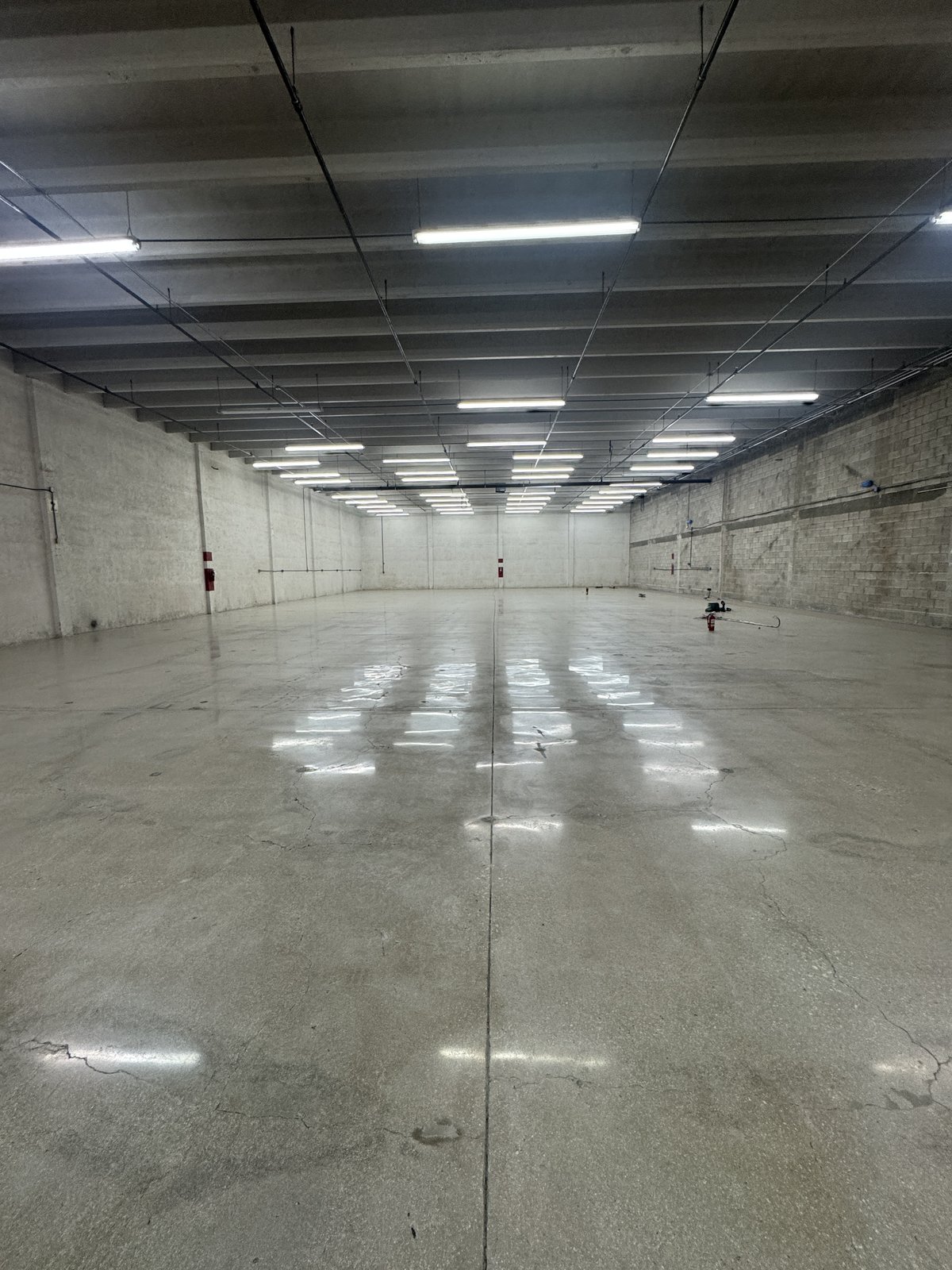
Polishing is the slab, not a coating over it
Every other system we install is something we put on top of your concrete. Polishing is different. There is no film. We open the slab with metal-bond diamonds, drive a lithium silicate densifier into the pores until the surface hardens chemically, then walk the floor back up through resin-bond grits until it reflects. What you end up standing on is the concrete you already paid for in 1987, or 2004, or whenever the tilt-wall went up.
That matters more in Miami than most places. A coating is only as good as its bond, and a bond is only as good as the moisture underneath it. South Florida slabs sit on a water table measured in a few feet, not a few dozen. Older ones were poured before vapor barriers were standard practice on commercial work. A polished floor has no bond line to break, so vapor drive that would blister an epoxy has nowhere to push. For a 40,000 square foot Airport West distribution floor with unknown slab history and no appetite for a moisture mitigation budget, that is the whole argument.
Coverage across Miami.
We install commercial Concrete Polishing across Miami and the surrounding trade area, phased around your operating hours rather than ours.
Three things that decide whether a polish holds up
Polishing looks like one machine going over a floor.
We read the slab before we quote a finish
Old patches, saw cuts, buried conduit chases, and adhesive from a floor covering nobody remembers all change what a polish can reach. A slab that was ground for a failed coating five years ago starts from a different place than a virgin warehouse pour.
Wet slip gets specified, not assumed
A polished floor at high gloss is fine dry and slick with water on it, which matters in a Miami building where somebody walks in during an afternoon downpour.
Dry work means the building keeps running
Grinding runs under vacuum extraction, so there is no slurry tracking down a corridor and no smell pushing anyone out. We take a bay or a corridor at a time behind a containment line and hand each piece back finished.
The aggregate question, answered before the machines land
Owners ask what the floor will look like. The honest answer is that it depends on how deep we cut and what your original finisher did with the mix, and nobody can promise you a photograph before the first pass. We can narrow it down considerably, though.
Cut shallow and you get a cream polish: the top paste, mostly uniform, closest to a smooth grey field. Cut a little deeper and you expose the fine sand, which is the salt-and-pepper look most Miami retail and office space ends up choosing because it hides scuffing and reads clean under LED. Cut deeper still and you open the large aggregate, which is dramatic in a lobby and expensive in a warehouse because it means removing a lot of material.
The complication in older Miami buildings is that slabs were rarely poured flat by modern standards, and many have been patched. A floor out of level by half an inch across a bay will expose aggregate on the high spots and stay at cream on the low spots no matter how carefully we run the machine. We show you that variation on a test panel first. Some owners love it and some want it corrected with an overlay, which is a different scope and a different number, and we would rather have that conversation on day one than on the day we hand the floor over.
Why Miami buildings keep choosing polish over film
Three local factors push this decision, and they are not the ones the national brochures list.
The first is moisture. Between the water table, the slab age, and eight months a year of dew point in the seventies, vapor emission readings on Miami commercial slabs come back high often enough that we test every one. A high reading does not kill a polish. It kills a coating budget, because you are suddenly buying a moisture mitigation system before you buy any floor at all.
The second is hurricane season, which is a scheduling problem more than a product problem. Between June and November a building can take water intrusion at a loading dock or a roof drain with no warning. A polished floor that gets flooded gets squeegeed, dried, and scrubbed. A coated floor that gets flooded and sits wet under a rack for three days can debond in patches, and then you are patching a film and it never matches.
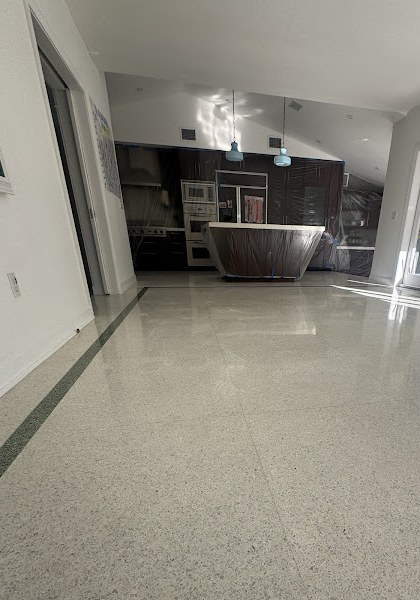
Miami buildings that keep specifying polish
The system earns its place where square footage is large, the slab is sound, and nobody wants a recoat cycle on the maintenance calendar.
Cross-dock and distribution floors
Airport West and Medley logistics space where a coating failure means roping off an aisle during a shift. Polished slab takes pallet-jack and forklift wheel loads without hot-tire pull, because there is no film to lift.
Ground-floor retail and showroom space
Design District showrooms and the retail bays under Brickell towers, where the floor has to read intentional under display lighting and take a scrubber every night with no maintenance contract behind it.
Institutional corridors and cafeterias
schools, clinics, and county buildings from Little Havana through Hialeah. Long runs, mop-and-scrubber cleaning, and a hard requirement that nothing off-gas or shut a wing for a week. Dry grinding with extraction lets us work one corridor at a time with classrooms and offices operating on both sides of the containment line.
Light industrial and production floors
Hialeah and Medley production space taking dropped tooling, point loads, and the occasional spill, usually run by somebody who has already watched one coating peel off this exact slab. Polished concrete cannot peel. Where a specific chemical genuinely lives in one bay, we polish the general floor and coat only that bay.
Why the water table decides this one
Most flooring decisions in this county come back to moisture, and polishing is the system that cares least about it. South Florida slabs sit a few feet above the water table, and plenty of the commercial stock went down before vapor barriers were standard on tilt-wall work. Vapor pushes upward through that slab every day of the year. A coating answers that pressure with a bond line, and a bond line is a thing that can fail.
The second half is what happens after a storm. Between June and November a loading dock or a roof drain lets water in with no warning, and a slab can sit wet under a rack for three days before anyone finds it. A polished floor gets squeegeed, dried, and scrubbed back to where it was. A coated floor in that same situation can debond in patches, and a patched film never matches the field around it.
- County
- Miami-Dade
- Best for
- High-square-foot retail, warehouse, institutional
- Key factor
- Moisture readings and slab history
- Typical job
- Phased by bay or corridor, building stays open
How a commercial polish runs on your floor
Walk-through and test cut
Free and on site.
Open and repair
Metal-bond diamonds open the surface. Cracks get chased and filled, saw cuts take semi-rigid filler, old adhesive comes off. All dry, all under vacuum.
Densify and refine
Lithium silicate goes in while the pores are open, then we walk the floor up through resin-bond grits to the finish level written in your quote.
Guard and handoff
Penetrating guard for stain resistance, a burnish pass, and a written cleaning routine your janitorial crew can follow. We come back at 30 days to look at the traffic lanes.
Other Suncrete coating systems.
The right system depends on the slab and the room. We will not force-fit one when another lasts longer in that space.
What facility managers ask us first.
How do I know if my slab is a good candidate for polishing?
It comes down to hardness, flatness, and what has been spilled on it. We cut a small test area during the walk-through and read the aggregate depth and surface hardness right there. Soft, dusting slabs can still be polished with a heavier densifier schedule. Slabs with heavy adhesive residue or a badly failed coating need the removal priced separately, and we will tell you that before you sign.
Can you polish while my Miami warehouse stays open?
Yes, and it is how most of these jobs run. Polishing is dry work with vacuum extraction, so there is no wet slurry tracking through your building and no strong smell shutting an aisle down. We take one bay or one corridor at a time, tape a containment line, and hand each section back as we finish it. Nights and weekends are available if your operation cannot give up floor space at all.
How does a polished floor hold up against forklift traffic?
Very well, which is why distribution floors keep specifying it. The densifier hardens the slab itself instead of laying a film on top, so there is nothing to lift under a hot tire or a pallet-jack turn. The wear point on a polished warehouse floor is almost always the saw-cut joints, not the field. We fill them with semi-rigid filler so wheels roll across instead of chipping the edges down.
Does a polished slab need to be sealed or waxed?
Never waxed. We put down a penetrating guard that lives inside the surface rather than on it, and after that the floor is maintained with an auto-scrubber and clean water. No stripping, no annual recoat, no burnishing crew. A high-traffic Miami retail floor might want a guard refresh somewhere around year four or five, which takes a night, not a shutdown.
What will polishing my Miami floor cost?
The walk-through and the quote are both free. Send square footage, a couple of photos, and what the space is used for, and you get a real number back within 24 hours. Price moves with slab condition, finish level, and how much removal is involved, so we would rather look at it than guess. Send the details here or call (786) 488-5057.
Got a slab? Let’s pour it right.
Photo plus square footage plus what happens in the room equals a real quote in 24 hours. Commercial Concrete Polishing across Miami and the surrounding area, on your hours.
See the work first
Finished commercial floors from across South Florida. Have a look, then tell us about your room.