Miami Commercial Concrete Sealing.
Penetrating sealers that protect the slab without changing how it looks or how it drains. For loading docks, plazas, parking decks, and every exterior commercial surface taking salt air and rain.
- Service
- Concrete Sealing
- Coverage
- Miami and Miami-Dade County
- Walk-on
- 24 hours after final coat
- Return to service
- 48 to 72 hours
- Lead time
- Walk-through usually within the week
- Quote
- (786) 488-5057
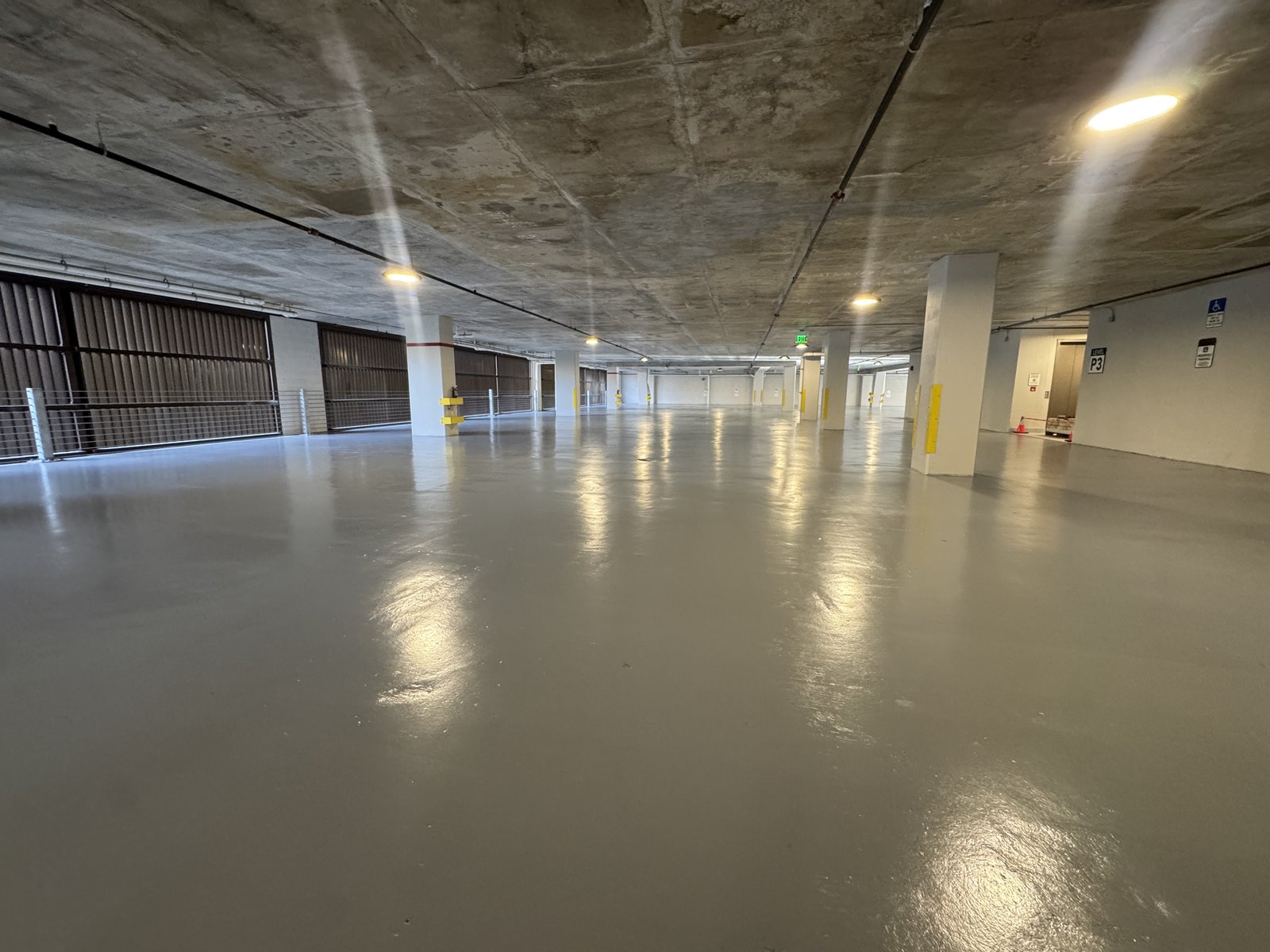
Sealing goes into the concrete, not onto it
There are two families of concrete sealer and they behave nothing alike, so it is worth being clear about which one we are talking about.
A film-forming sealer sits on the surface as a thin layer. It gives you gloss and it darkens the concrete, and on an exterior Miami slab it is usually a mistake. It traps moisture trying to leave the slab, it turns slick in rain, and it eventually peels in the sun. The other family is penetrating: silanes, siloxanes, and lithium silicate densifiers that soak into the pore structure and react chemically inside the concrete. There is no film. The slab still breathes, the surface texture and slip resistance stay exactly as they were, and water beads and runs off instead of soaking in.
For essentially every exterior commercial surface in Miami, penetrating is the correct answer. Loading docks, plaza and courtyard hardscape, walkways, ramps, parking decks, pool surrounds, and equipment pads. The floor looks the same the week after we seal it, which is exactly the point. You are buying protection, not appearance.
Coverage across Miami.
We install concrete Sealing across Miami and the surrounding trade area, phased around your operating hours rather than ours.
The simplest thing we install is the easiest one to get wrong
Sealing looks like spraying liquid on concrete, so it attracts crews who treat it that way. Three variables decide whether the product ever reaches depth.
Chosen against the exposure, not the price sheet
A dock apron, a shaded plaza, and an interior warehouse slab want three different chemistries. Silane where chloride is the threat on an exposed deck. A siloxane blend for general exterior water repellency on hardscape.
Applied wet, at spec, on a slab that is actually dry
Coverage rate and slab moisture at the moment of application are the two things that decide performance. Sprayed over a slab still holding rain from yesterday, the pores are full and the product cannot travel. Stretched thin to save a drum, it never reaches depth.
A refresh interval you can put in a budget
We tell you what your specific surface should get and roughly when, generally somewhere between three and seven years depending on exposure and traffic, and we write it into the handoff.
What salt actually does to a Miami slab
Chloride is the reason this service exists in South Florida, and the mechanism is worth understanding because it explains why the damage shows up years after the exposure starts.
Salt-laden air off the bay and the ocean settles onto exterior concrete continuously. Rain drives those chlorides down into the pore structure. Concrete is porous, so they travel, and when they reach the reinforcing steel they break down the passive layer that normally protects it and corrosion begins. Rusting steel expands, and it expands with enough force to crack the concrete around it from the inside. That is what spalling is, and it is why you see the same failure pattern on parking decks, balcony edges, and dock aprons all over this county: a rust stain, then a hairline, then a chunk missing.
A penetrating sealer will not reverse corrosion that has already begun. What it does is dramatically slow the water and chloride getting in, which slows the whole clock. On a structure within a mile of open water that difference compounds over decades, and it is a genuinely small line item against the cost of concrete restoration on a deck.
Timing sealing around Miami weather
Application timing matters more here than almost anywhere, and it is the single most common reason a sealer underperforms in this market.
Penetrating sealers need a dry slab and a dry window. Concrete still holding water from yesterday’s rain will not take the product to depth, because the pores are already full. We moisture-check before we spray, not only before we schedule, and we will push a job a day rather than apply into a slab that is not ready. In a Miami summer that means we watch the afternoon pattern closely and often start early, because a 3pm thunderstorm four hours after application on an exterior slab can wash product off before it has cured in.
The other timing question is the season. The best window for exterior commercial sealing in Miami-Dade runs through the drier months, roughly December into April, when you get long dry stretches and lower humidity. That is not a hard rule and we seal year round, but if you are planning a capital item on a large plaza or deck rather than reacting to a problem, scheduling it in the dry season gets a better result and a faster job.
Surfaces we seal across Miami-Dade
Exterior commercial concrete taking salt, rain, and traffic, plus the interior slabs that mainly need hardening rather than a finish.
Loading docks and service yards
dock aprons, truck wells, and yards through Doral, Medley, and Airport West. These slabs take diesel drip, hydraulic fluid, trailer-leg point loads, and rainwater that sits until it evaporates.
Plazas, courtyards, and entry hardscape
forecourts, courtyards, and walkways through Brickell, Downtown, and the Design District. The requirement here is protection that leaves appearance and wet slip resistance completely alone, because a glossy plaza during a Miami afternoon downpour is a liability with a lawyer attached. Penetrating chemistry does that. Film-forming sealers absolutely do not.
Parking decks and ramps
structured and surface parking taking chloride, tire traffic, and daily thermal cycling. Silane treatment is the standard specification for chloride resistance on a deck, and applied on a schedule it costs a small fraction of the concrete restoration that follows once spalling starts opening up along the drive lanes.
Waterfront and dock-adjacent slabs
equipment pads, staging aprons, and back-of-house concrete near PortMiami and along the marina frontage, where salt exposure is constant rather than occasional. These are the slabs where a sealing cycle pays back most visibly, because the untreated ones nearby are already telling you what happens.
Timing matters more here than the product does
Application timing is the single most common reason a sealer underperforms in this market, and it has nothing to do with which drum was bought. Penetrating sealers need a dry slab and a dry window on both ends.
Season is the other half. The best window for exterior commercial sealing in Miami-Dade runs roughly December into April, when the dry stretches are long and the humidity drops. That is not a hard rule and we seal year round when a dock needs it, but if you are planning a large plaza or deck as a capital item rather than reacting to a problem, scheduling it in the dry season buys a better result and a faster job.
- County
- Miami-Dade
- Best for
- Docks, plazas, decks, waterfront slabs
- Key factor
- Chloride load and a dry application window
- Typical job
- Sectioned overnight or across a weekend
How a sealing job runs on an operating site
Walk-through
Free and on site. We read the exposure, look for staining and early spalling, check whether anything was sealed here before, and name the chemistry the surface wants.
Clean and open
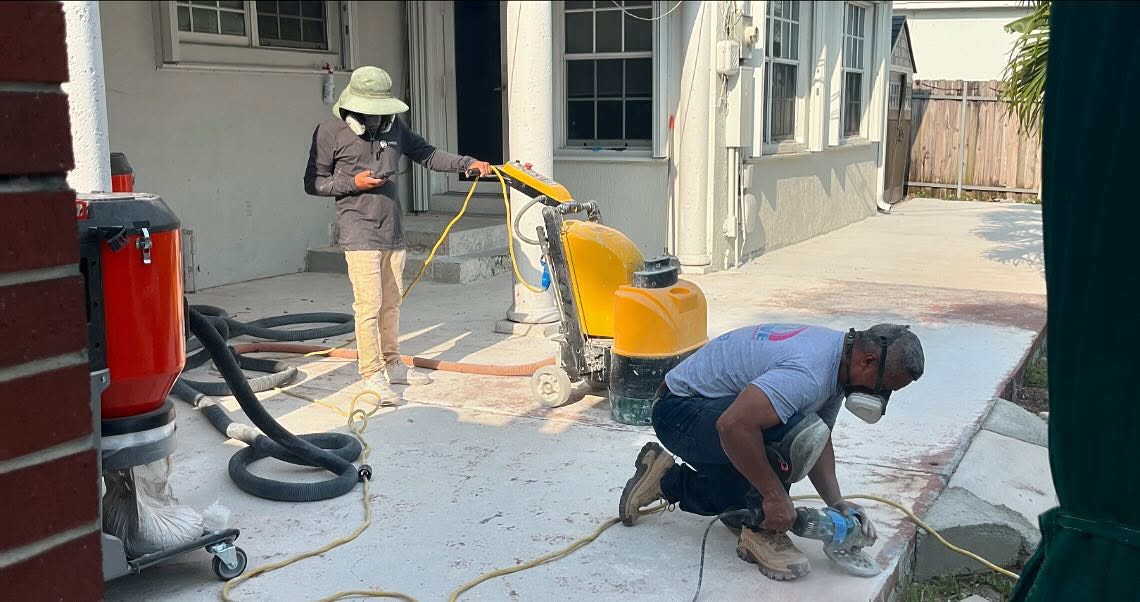
Pressure wash or mechanically clean, degrease oil-contaminated areas, strip any old film-forming sealer in the way, then let the slab dry to the moisture level the product needs.
Apply at rate
Sprayed and back-rolled at the specified coverage rate inside the weather window, with the crew watching the forecast rather than the clock. Second application where the substrate calls for it.
Cure and handoff
Most surfaces take foot traffic in a few hours and vehicles the next day. You get the product data, the rate we actually used, and the refresh interval in writing.
Other Suncrete coating systems.
The right system depends on the slab and the room. We will not force-fit one when another lasts longer in that space.
What facility managers ask us first.
Will sealing change how my concrete looks?
A penetrating sealer will not. It reacts inside the pore structure rather than sitting on the surface, so color, texture, and slip resistance stay as they were and water beads instead of soaking in. Film-forming sealers do change the look, adding gloss and darkening the slab, and we generally steer commercial clients away from those on any exterior Miami surface for exactly that reason.
How often does a Miami commercial slab need resealing?
Roughly every three to seven years, driven by exposure and traffic more than by time. A bayfront dock apron or a parking deck taking salt air constantly sits at the short end. A covered interior warehouse floor sits at the long end. The practical test is water: when it stops beading and starts darkening the slab, the sealer has given up and it is time.
Can you seal a dock or plaza while the building operates?
Yes. We take it in sections and hand each one back as it cures. Most penetrating sealers accept foot traffic within a few hours and vehicles the next day, so a dock can usually be done overnight or across a Sunday with no interruption to shipping. The bigger scheduling constraint is weather, not your operation, because the slab needs a dry window.
Will sealing stop the spalling on my parking deck?
It will slow it considerably and it will not undo it. Once chlorides have reached the reinforcing steel and corrosion has started, that section needs concrete repair, because expanding rust keeps pushing the concrete off from the inside. The right sequence is repair the damaged areas first, then seal the whole deck to slow the chloride reaching the steel everywhere else.
What does sealing a Miami commercial slab cost?
The walk-through and the quote are free. Price moves with square footage, how much cleaning or old sealer removal the slab needs, and which chemistry the exposure calls for. Send square footage, a couple of photos, and where the surface sits relative to the water, and you get a real number back within 24 hours. Send the details here or call (786) 488-5057.
Got a slab? Let’s pour it right.
Photo plus square footage plus what happens in the room equals a real quote in 24 hours. Concrete Sealing across Miami and the surrounding area, on your hours.
See the work first
Finished commercial floors from across South Florida. Have a look, then tell us about your room.