Acid and Chemical Resistant Novolac Epoxy.
Battery acid, degreasers, hot wash water and caustic cleaners strip a standard epoxy floor. Novolac resin holds where the ordinary stuff blisters, softens and lifts off the slab.
- Service
- Chemical Resistant Novolac Epoxy
- Build
- 20 to 250 mil, application dependent
- Coverage
- ~100 mi · Miami → West Palm
- Walk-on
- 24 hours after final coat
- Return to service
- 72 hours for full chemical cure
- Quote
- (786) 488-5057
What novolac actually is
Standard commercial epoxy is built on bisphenol A resin. It handles oil, foot traffic, forklifts and normal cleaning chemistry for a decade, and it is what we put down on most warehouse slabs in Miami-Dade. It is the wrong floor the moment sulfuric acid, hot caustics or aggressive solvents land on it every week.
Charging stations
Charging stations and washing stations are the two rooms we get called about most.
Wash bays and washing stations
Everybody assumes a wash bay problem is water. Water is the easy part. The hard part is what is dissolved in it: truck wash detergents that run alkaline, wheel cleaners that run acidic, degreasers loaded with butyl solvent, all of it at temperature, under pressure, hitting the same corners day after day.
A wash station floor has to do four things at once. Resist that chemistry. Shed water to a drain instead of holding puddles. Stay walkable when it is wet and soapy. And keep water out of the wall base and the slab edge.
Coverage across Miami Beach.
We install chemical Resistant Novolac Epoxy across Miami Beach and the surrounding trade area, phased around your operating hours rather than ours.
Sized to the exposure, not to a catalog page
Three builds cover almost every room we get called into. Which one you need comes down to what lands on the floor, how hot it is when it lands, and how often.
Thin film, 20 to 40 mil
Light chemical duty. A lab bench area, a storage room that sees the occasional spill. Fast to install and the easiest of the three to clean, but it is also the least tolerant of a rough slab, so the prep has to be right underneath it.
Broadcast build, 60 to 125 mil
The common one, and what most charging bays and wash stations get. Quartz or aluminum oxide broadcast into a novolac body coat, then a novolac or chemical-grade urethane topcoat over it. Slip resistance built into the floor, real thickness over the slab, still cleanable.
Mortar build, 1/4 inch and up
Heavy spill zones, hot chemical, dropped tooling and impact. Trowel-applied, so it costs more and takes longer than the other two. It is also the only thing that survives some rooms, and we will say so when a room is one of them.
The rest of the list
Chemical storage and secondary containment. Drum storage rooms, dike areas, mixing rooms. Novolac at higher build with a coved curb turns the room into a basin that holds what spills instead of soaking it into the slab.
Food processing with aggressive sanitation. Not every food plant needs novolac. Plenty are fine on urethane cement, which is what we put in most commercial kitchens. Novolac earns its place where sanitation runs strong acid or caustic on a schedule, or where the product itself is acidic. Citrus, dairy whey, brine, vinegar and pickling lines chew through ordinary floors.
Cove and topcoat
Coved integral base is standard on anything wet or chemical and we do not treat it as an option. A floor that stops at the wall has a seam at the wall, and the seam is where liquid gets under the system. We build the cove out of the same material as the floor so there is no joint to fail.
Topcoat choice is a real decision. A novolac topcoat gives the best chemical numbers. A chemical-grade urethane topcoat gives up a little chemical resistance and buys back UV stability and abrasion resistance, which matters on a bay with a roll-up door where half the floor sees direct sun. On a covered indoor bay we stay novolac all the way up. On an exposed one we talk it through at the walkthrough.
Where novolac is the wrong call
Novolac is not a cure-all and we lose jobs saying so.
It has a shorter working time than standard epoxy, and Miami heat shortens that window further, which is why we schedule chemical work for early mornings and bring our own climate control on tight rooms. A crew that has not run the material before will leave roller marks and cold joints in it.
What it costs you to wait
A charging bay slab that has been taking electrolyte for six years is not a coating job anymore, it is a concrete repair job with a coating on top. Pitting gets saw-cut and patched, spalled edges rebuilt, and the patch material has to be compatible with the resin going over it. All billable work that would not exist if the floor had been sealed when the room was commissioned.
Same story in a wash bay. Water that gets under a failing coating tracks to the wall base, sits in the block cell, and comes back as efflorescence and rusting anchor bolts. By the time it shows on the outside of the wall, the block behind a wash bay can be saturated enough to give under a screwdriver, which is why the wall base gets checked at the walkthrough and not assumed sound because the paint looks fine.

Four rooms where the resin choice is not close
Novolac is a specialist system and these are the rooms that need one. What they share is chemistry that arrives on a schedule rather than by accident.
Forklift and battery charging rooms
The exposure here is not one dramatic spill, it is a slow drip nobody logs. Caps weep during gassing, a cell gets topped off, and a thin film of electrolyte spreads under the racks where nobody walks or mops.
Vehicle and equipment wash bays
The chemistry in a wash bay swings all day. An alkaline truck soap at eight in the morning, an acidic wheel cleaner at ten, a butyl degreaser after lunch, all of it hot and under pressure.
Chemical storage and secondary containment
Containment rooms are judged on the day something goes wrong, and everything about them is designed for a spill that may never come. That is exactly why they get skipped.
Food processing with aggressive sanitation
The floor in a plant like this is attacked by the cleaning, not by the food. Caustic foam overnight, an acid rinse on rotation, then hot water over all of it.
What South Florida adds to the exposure
Chemical attack is a temperature problem before it is anything else. Reaction rates climb with heat, and a slab in an uncooled Miami-Dade building sits warmer for more of the year than the same slab anywhere north of here. A caustic that a floor would shrug off at sixty degrees works considerably harder at ninety five, so a coating specified against a national data sheet is quietly being asked for more than the sheet promised.
Then there is water, from underneath and from outside. Vapor drives up through a South Florida slab all year, and salt air off the water carries into an open bay every time the roll-up door goes up, settling into concrete pores and around anchor bolts.
- County
- Miami-Dade
- Best for
- Charging bays, wash stations, containment, processing
- Key factor
- Heat accelerating chemical attack and slab vapor drive
- Typical job
- Friday evening down, Monday back in service
How a novolac install runs
Walkthrough and moisture meter
We see the room in operation, meter the slab, and photograph it. High vapor drive means a mitigation coat goes in the scope or the job does not get done.
Diamond grind to profile
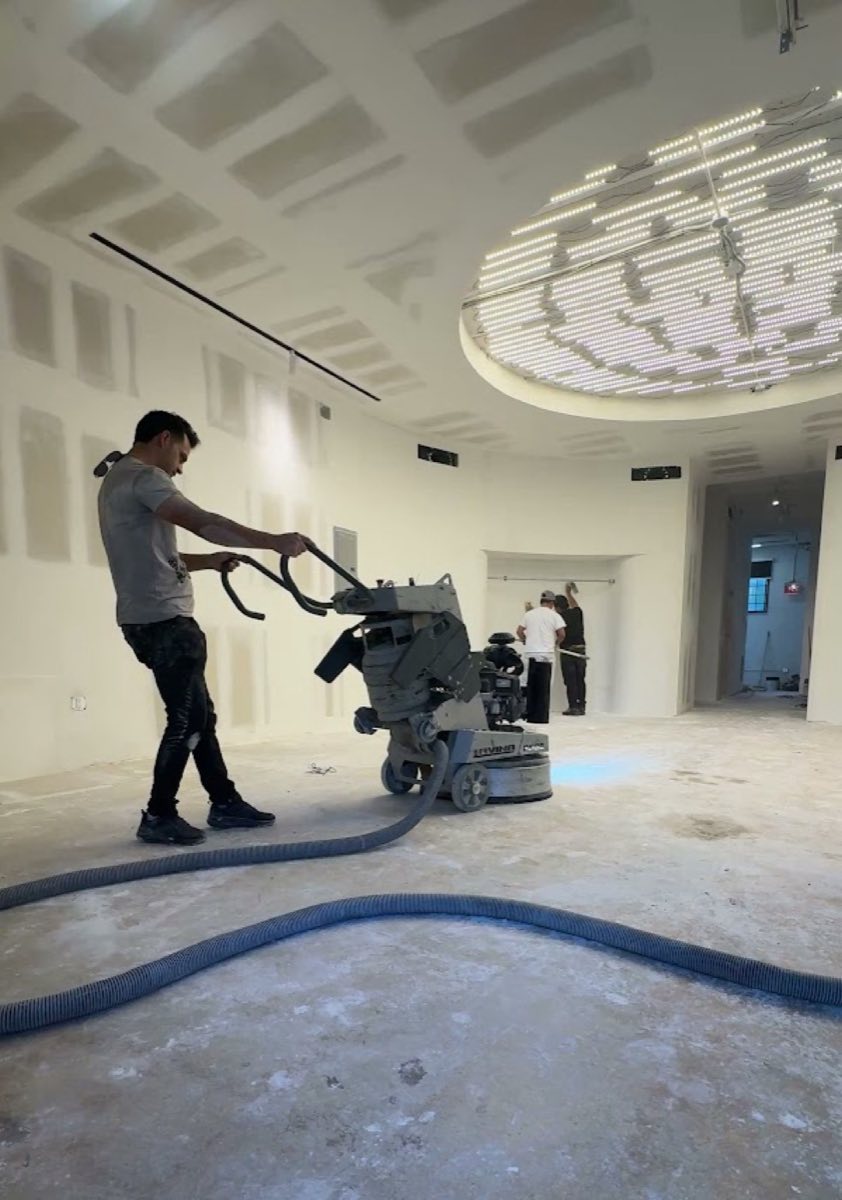
CSP 2 or 3 depending on build, shot blasting where the area justifies the machine. Existing coating comes off mechanically, never chemically.
Cracks, joints and drains
Cracks chased, filled with a rigid epoxy and reprofiled. Moving joints honored through the system. Drains cut in and recessed.
Prime, build, cove, topcoat
Primer the same day the profile is cut. Body coat, broadcast, integral cove and topcoat follow in sequence, then cure to service.
Other Suncrete coating systems.
The right system depends on the slab and the room. We will not force-fit one when another lasts longer in that space.
What facility managers ask us first.
Is Novolac the same as regular epoxy?
No. Regular commercial epoxy uses a bisphenol A resin. Novolac uses a phenol based resin with more reactive sites, so it cures into a much denser crosslink network. That density is what resists acids and solvents. Both are epoxies, both go down over prepped concrete, but under aggressive chemistry they behave nothing alike.
Will it handle battery acid from forklift charging?
Yes, that is one of the two applications this system is built around. Sulfuric electrolyte at charging-room concentrations is well within what a properly built novolac system handles. We add a coved integral base and, where the room needs containment, a perimeter curb so a spill stays in the bay instead of finding the wall joint.
How long is the bay out of service?
Most rooms go down Friday evening and come back Monday morning. Walk-on traffic at 24 hours after the final coat, forklifts at 48, and full chemical resistance at roughly 72 hours in South Florida temperatures. On large facilities we section the work so only part of the area is offline at a time.
Can you put it over the coating that is already there?
Almost never, and we will not guess. Existing coatings come off mechanically because a novolac system is only as good as its bond to sound concrete, and old coating that has been soaking oil or acid is not a bond surface. Grinding also lets us meter the slab for moisture, which is the other thing that decides whether the floor lasts.
Do I really need Novolac, or is standard epoxy enough?
Often standard epoxy is enough, and we say so. If the room only sees water, oil and normal cleaners, novolac is resistance you pay for and never use. It earns its cost where acid, caustic or solvent hits the same floor on a schedule. The walkthrough answers it, not the catalog.
Got a slab? Let’s pour it right.
Photo plus square footage plus what happens in the room equals a real quote in 24 hours. Chemical Resistant Novolac Epoxy across Miami Beach and the surrounding area, on your hours.
See the work first
Finished commercial floors from across South Florida. Have a look, then tell us about your room.