Flake floors that hide a hard week.
Vinyl chip broadcast into resin and locked under urethane. Traction underfoot, dirt disappears between cleanings, and patch lines stop showing.
- Service
- Commercial flake epoxy
- Coverage
- Fort Lauderdale and Broward County
- Chip
- Stock blends or custom brand colors
- Install
- Two to three nights, phased by room
- Walk-on
- 24 hours, equipment at 48 to 72
- Quote
- (786) 488-5057
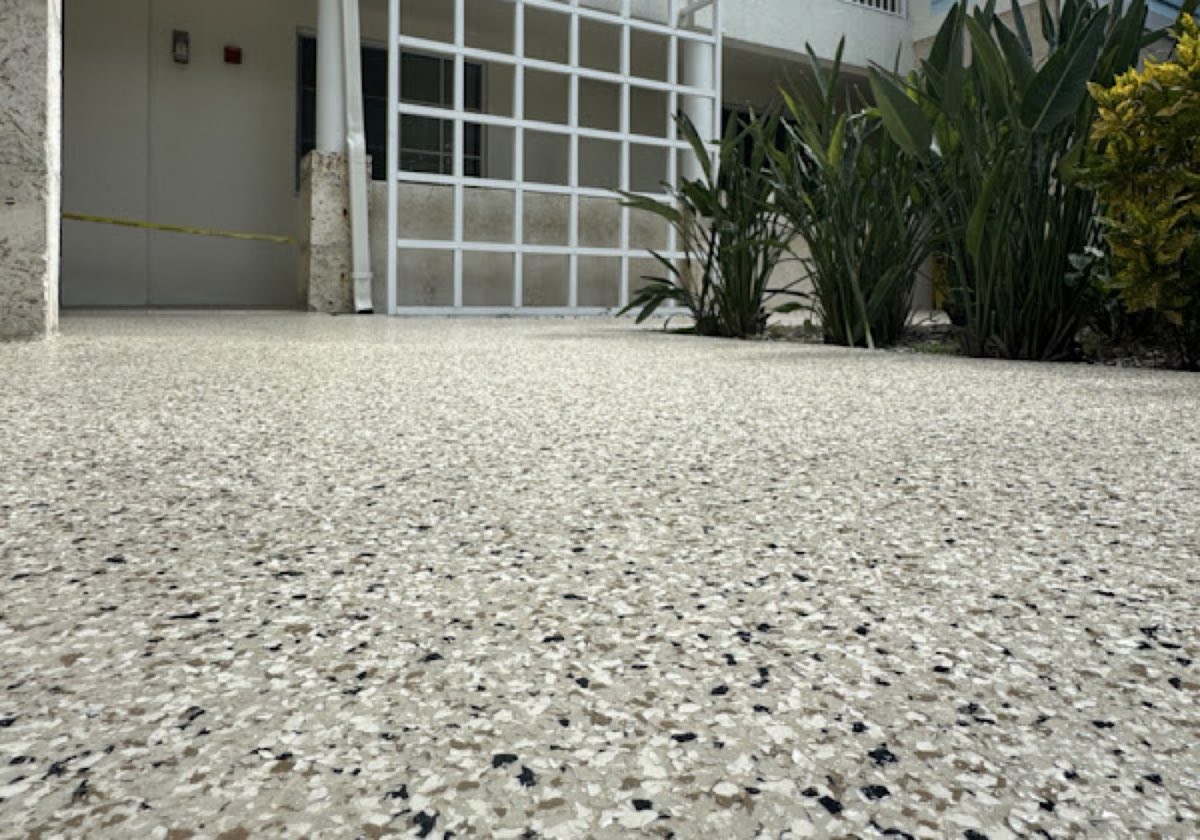
Traction where staff actually walk
The chip creates a naturally textured surface. Sanded back and sealed, it gives real grip without turning into a floor nobody can mop.
We can push that further where it matters. A heavier chip, a coarser broadcast, or an aggregate added into the urethane topcoat raises the traction profile in specific zones: entries where rain comes in off Andrews or Sunrise, locker room and shower approaches, dish pits, wash-down corners, and ramps. The rest of the room stays smoother so cleaning does not become a daily fight.
Grading traction zone by zone is how you get safety and easy maintenance at the same time. Blanketing an entire floor with aggressive texture gets you neither, because the crew stops being able to clean it and it fills with grime.
Chip, color, and matching a brand
Chip comes in a wide range of sizes and blends, and the size changes the look more than people expect. A quarter-inch chip reads busy and textured, closer to terrazzo. A one-eighth chip reads tighter and more uniform from standing height.
Base coat color shows through slightly in the gaps and shifts the whole tone, so a grey blend over black base and the same blend over tan base are noticeably different floors. We bring samples to the walkthrough and set them on your actual floor under your actual lighting, because a chip blend under warm restaurant lighting is not the same blend under a warehouse’s cool LEDs.
Custom blends can be mixed to hit brand colors for gyms, franchises, dispensaries, and taprooms.
Coverage across Fort Lauderdale.
We install commercial Flake Epoxy across Fort Lauderdale and the surrounding trade area, phased around your operating hours rather than ours.
A working floor that still looks maintained
Flake gets picked for two reasons that have nothing to do with resin chemistry.
The pattern absorbs a hard week
A solid color floor is unforgiving. Every scuff, every dropped bolt mark, every dust bunny in a corner, and every patch where somebody cut in a new drain reads as an obvious interruption. Variegated chip breaks all of that up visually.
Traction graded zone by zone
The chip creates real texture, and we can push it further where it matters. A heavier chip, a coarser broadcast, or aggregate worked into the urethane raises the profile at entries, locker and shower approaches, dish pits, wash corners, and ramps.
Encapsulated, not sprinkled on
Epoxy base over profiled concrete, chip broadcast into it wet to full refusal, then scraped and sanded to knock the sharp edges down, then sealed under two or three coats of clear urethane. The chip is inside the system, not sitting on it.
The Fort Lauderdale rooms that get flake
Locker rooms and gyms are the natural fit. Wet feet, dropped weights, high traffic, and a room that has to look decent to sell memberships.
Clinics and veterinary practices are a big one. Exam rooms and kennel runs need a seamless, sanitary, easy-to-disinfect floor with grip, and the chip pattern hides the reality of what happens on it between cleanings.
Brewery taprooms and restaurant back-of-house both work. Production side gets the chemical-tolerant build with heavy traction; the guest side gets a chip blend that looks intentional.
Then there is the practical middle: service corridors, break rooms, restrooms, retail stockrooms, auto and marine service bays where a bare epoxy floor would show every oil drip, and the small-shop spaces off Sistrunk and around Executive Airport where one room has to do six jobs.
Building it for a Broward slab
Same prep discipline as any coating we install, because the flake system is only as good as what it is stuck to.
Diamond grind to profile. Moisture-test before and after, because Broward’s water table does not care what finish you picked. Route and fill cracks, honor control joints, cut in at drains, rebuild spalled thresholds. High moisture readings get a mitigating primer and you hear about it before the contract.
One local detail worth knowing: where a flake floor gets sun, from a storefront glass line, a roll-up door, or a covered service bay, we finish with an aliphatic urethane topcoat rather than a standard one. Regular epoxy topcoats amber under Fort Lauderdale UV, and on a light chip blend that yellowing is extremely visible.
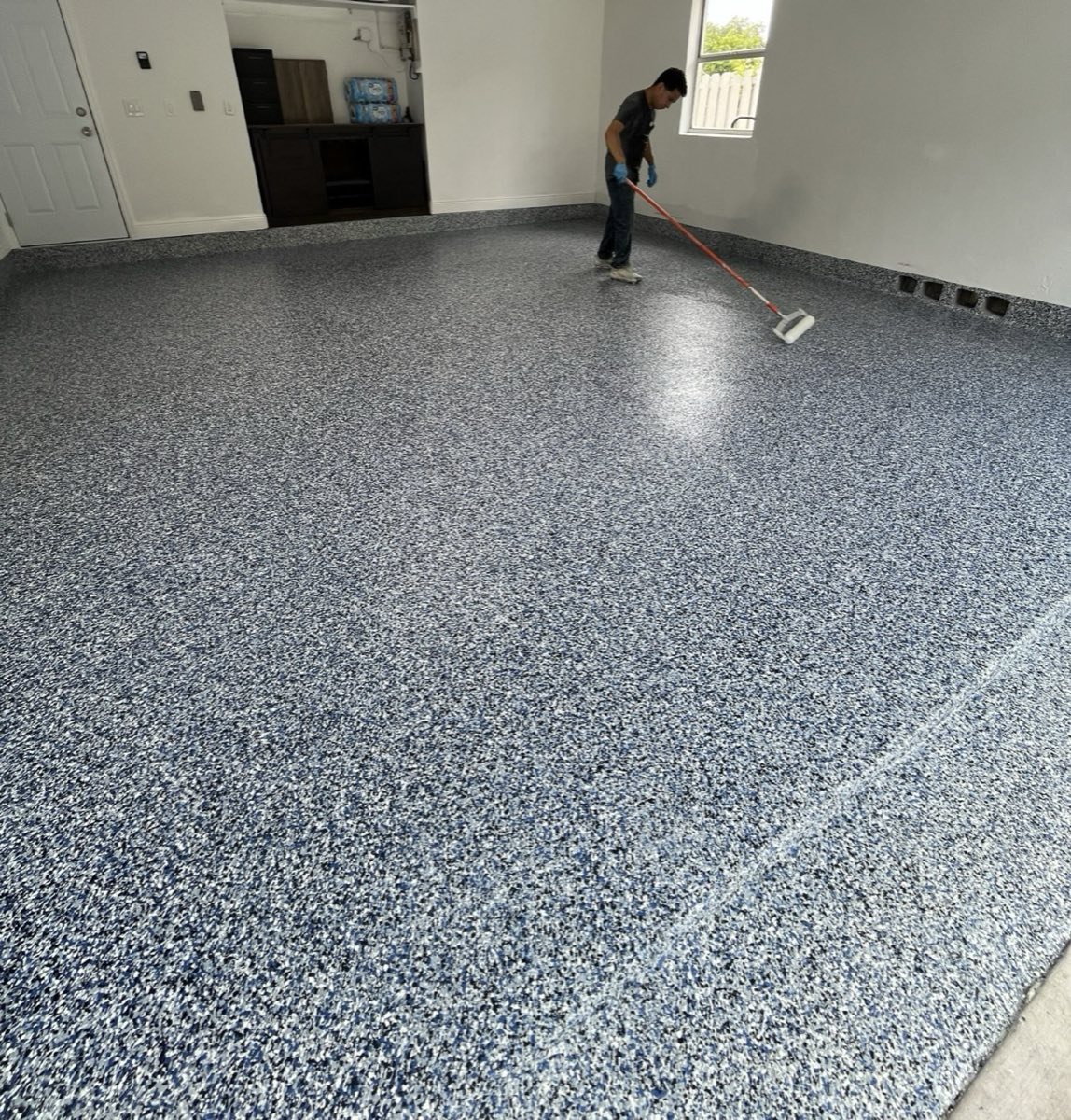
The Fort Lauderdale rooms that get flake
Wet feet, dropped things, high traffic, and a room that still has to look decent to a customer. That combination is where flake beats everything else we install.
Locker rooms and gyms
The natural fit and one of our steadiest commercial lanes. Wet feet off showers, dropped weights, constant traffic, and a room that has to look good enough to sell memberships.
Clinics and veterinary practices
Exam rooms and kennel runs need a seamless, disinfectant-tolerant surface with grip underfoot, and the chip pattern hides the honest reality of what happens on those floors between cleanings. Cove base goes up where infection control asks for it.
Taprooms and restaurant back-of-house
One building, two specs. The production side and the dish pit take a chemical-tolerant build with heavy traction broadcast where water lands. The guest side gets a chip blend that looks deliberate under warm lighting.
Service corridors and shop bays
The practical middle. Break rooms, restrooms, retail stockrooms, auto and marine service bays where bare epoxy would show every oil drip, and the small-shop spaces off Sistrunk and around Executive Airport where one room has to do six different jobs.
Building a chip floor for Broward light and moisture
Two local conditions change how we spec a flake system here, and the second one catches people out. Prep discipline is the first, and it is identical to any other coating we install, because a flake system is only ever as good as the thing it is stuck to. Diamond grind to profile, meter the slab before and after the grind, route and fill cracks, honor control joints, cut in at drains, and rebuild spalled thresholds.
The second is sunlight, and it is specific to light chip blends. Anywhere the floor sees daylight through a storefront glass line, a roll-up door, or a covered service bay, we finish with an aliphatic urethane topcoat rather than a standard one. Regular epoxy topcoats amber under Fort Lauderdale UV, and on a pale grey or white blend that yellowing is the most visible failure on the floor.
- County
- Broward
- Best for
- Wet, high-traffic staff areas
- Key factor
- Traction zones and UV exposure
- Typical job
- Clinic, gym, taproom, or service corridor
How a flake install splits across nights
Night one
Prep and grind to profile, moisture check, repairs, then the epoxy base coat with the chip broadcast thrown to full refusal while it is still wet.
Night two
Scrape the sharp chip edges down, sand, vacuum thoroughly, then the first clear urethane coat goes over the whole room.
Night three
Final urethane coat, heavier build in the traffic lanes, with traction aggregate worked into the zones we mapped at the walkthrough.
Return to service
Walk-on about 24 hours after the last coat. Mats, carts, and equipment at 48 to 72, scheduled backward from your reset date.
Other Suncrete coating systems.
The right system depends on the slab and the room. We will not force-fit one when another lasts longer in that space.
What facility managers ask us first.
Will the chips come loose over time?
No, if it was built correctly. The chip is broadcast into wet epoxy and fully embedded, then sealed under two or three coats of urethane, so it is encapsulated rather than sitting on the surface. Chip loss happens when a crew broadcasts into a base coat that has already started setting, or skips the urethane build to save cost. Neither happens on our installs.
Is flake tough enough for a commercial room, or is it a residential product?
It is a full commercial system when it is specified as one. The strength comes from the epoxy base and the urethane topcoat build, and we can size both for the traffic. What flake does not do is take heavy forklift point loads as well as a high-build industrial epoxy, so for a loaded warehouse aisle we would steer you elsewhere.
Can you match our brand colors?
Usually, yes. Chip is available in many stock blends and custom blends can be mixed to hit specific colors, which gyms, franchises, taprooms, and dispensaries around Fort Lauderdale ask for regularly. The base coat color underneath shifts the final tone too, so we set physical samples in your room under your lighting before you choose.
How does it clean compared to a solid epoxy floor?
Roughly the same effort, better result. Both are sealed and non-porous, so spills stay on top. The difference is that the chip pattern hides the dirt that accumulates between cleanings, while a solid color shows everything. Dust mop and auto-scrub with a neutral-pH cleaner is the whole routine on either one.
Will it yellow in the sun?
A standard epoxy topcoat will, and on a light chip blend that is very visible. Anywhere the floor sees Fort Lauderdale sun through a storefront, a roll-up door, or a covered bay, we finish with an aliphatic urethane topcoat instead, which is UV stable. It is a spec choice we make at the walkthrough based on where the light actually falls in your room.
Got a slab? Let’s pour it right.
Photo plus square footage plus what happens in the room equals a real quote in 24 hours. Commercial Flake Epoxy across Fort Lauderdale and the surrounding area, on your hours.
See the work first
Finished commercial floors from across South Florida. Have a look, then tell us about your room.