Hialeah Gardens gym and walkway floors.
Chip-broadcast epoxy for the commercial rooms people use every day: training floors, break rooms, back-of-house corridors and the waiting area at an auto shop. The texture hides the scuffs that a busy room puts on a floor every single day.
- Service
- Commercial flake epoxy
- Coverage
- Hialeah Gardens + Miami-Dade
- Base
- Ground and crack-repaired slab
- Body
- Epoxy with a full chip broadcast
- Finish
- Clear topcoat, grit where wet
- Quote
- (786) 488-5057
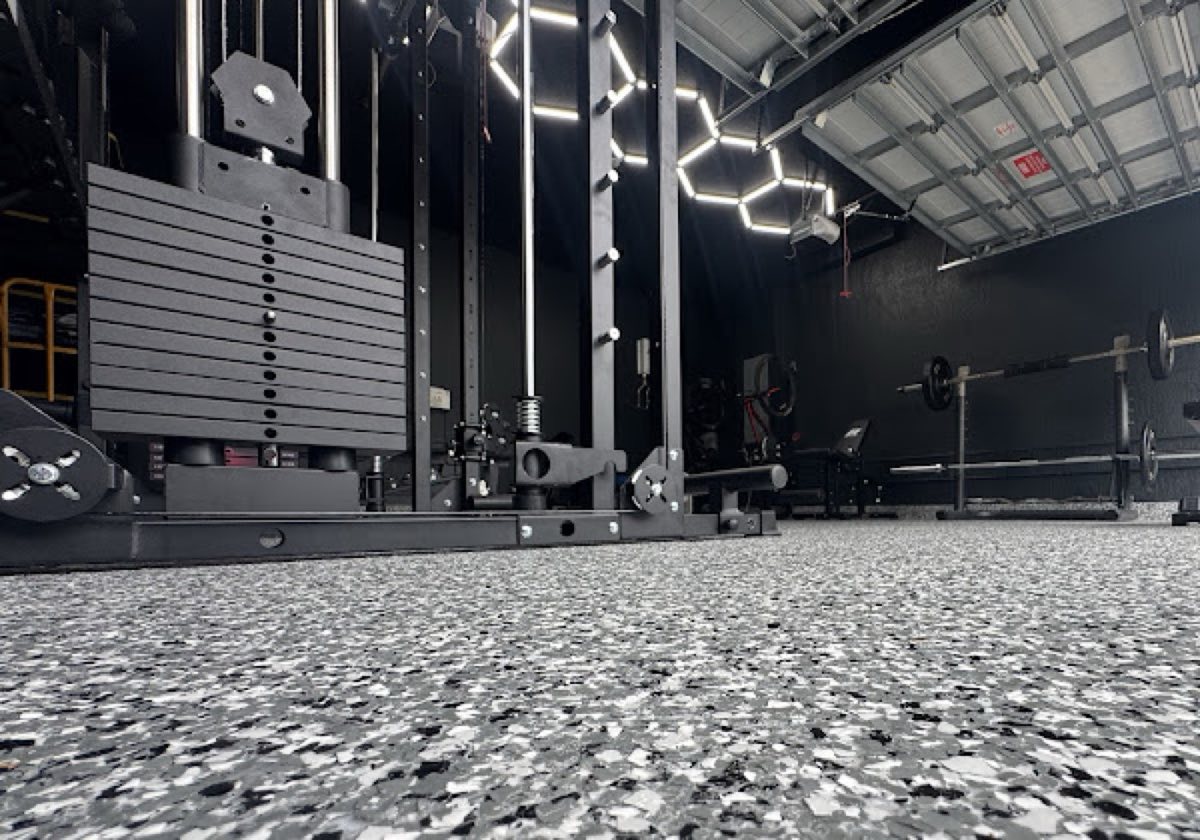
Rooms people cross all day long.
A flake floor is built in layers. We diamond-grind the slab, repair the cracks and prime it, then roll a colored epoxy body coat and throw vinyl chips into the wet resin until no base color shows through. Once it cures we scrape off the loose chips, vacuum the room, and seal everything under a clear topcoat. What you walk on is a hard, lightly textured surface with the pattern locked under the clear coat.
That pattern is the whole reason we put flake in commercial rooms. A solid color shows every sneaker scuff, cart track and dropped plate. A broadcast of gray, black and white chips breaks up the eye, so a training gym still looks clean at the end of a heavy day, and the small marks from a dropped dumbbell disappear into the blend.
We are straight with gym owners about one limit. Where barbells come down from overhead, any resin floor is the wrong surface, so we leave room in the layout for rubber platforms there. Flake covers everything around them: the cable stations, the dumbbell racks, the walkways and the front desk.
Building walkways and common corridors follow the same logic at a different scale. A cream and white blend beside planting and storefront glass reads clean and bright, and it forgives the sand, leaf litter and wet footprints that come in with every rain. Property managers tend to like that a routine scrub brings the floor back without any stripping or waxing.
Gyms, shops and retail around Hialeah Gardens.
The city sits next to Hialeah and falls on our crew’s regular weekly route, so a walkthrough usually lands in the same week you call. Commercial epoxy and decorative flake are both available here for retail spaces, gyms and back-of-house floors, and the handful of automotive shops in town have customer areas that suit the system well. Photos from past floors are in the gallery, and the city overview lives on our Hialeah Gardens page.
Wet floors, wall bases and drains.
Three details decide how a flake floor behaves once a room gets busy. We settle all three on the walkthrough, long before the first coat is mixed.
Grip in the topcoat
Flake on its own has a mild texture. Near showers, water fountains, entry doors and covered walkways, we mix a fine grit into the clear topcoat so wet sneakers hold. Less grit goes where the floor needs to squeegee easily.
A curved wall base
In break rooms and locker areas we carry the coating up the wall in a cove. Mop water never reaches the drywall, and there is no corner seam for dirt to pack into.
A clean finish at the grate
Around a floor drain we finish the coating tight to the drain body, so water leaves the floor and nothing has an edge to lift from. The chips stop short of the grate itself.
Where a chip floor belongs.
These cover most of our commercial flake work. Every one gets the same prep. What changes is the chip blend, the amount of grit, and how we stage the install around the people using the room.
Gyms and training floors
Strength rooms, group class floors and personal training studios. The blend hides chalk dust and rubber marks, cleans up with a neutral cleaner and an auto-scrubber, and gives you an open surface for taped lanes or workout zones.
Retail back-of-house
Receiving corridors, stock areas behind the sales floor and staff rooms. Pallet jacks and carts scuff a plain coating quickly, and a busy chip blend keeps that wear out of sight between deliveries.
Break rooms and staff kitchens
Coffee, soda and dropped lunches all land here. A sealed flake floor wipes clean, the cove base keeps mop water off the walls, and the room finally looks finished instead of left over.
Auto shop waiting areas and walkways
The customer side of a service shop, plus building walkways and common corridors. Grease tracked in from the bays disappears into a darker blend, and grit in the topcoat keeps a rain-soaked walkway safe underfoot.
Picking chips for the light and the logo.
Chip color does more work than people expect. Under bright LED panels a high-contrast blend can read busy, so we lean toward fewer colors in closer tones. In a dim back corridor, a lighter base with cream and white chips lifts the whole room and makes a dropped screw easy to find.
Brand color works best as an accent. A small share of a gym’s red or a shop’s blue mixed into a neutral blend looks deliberate, while a floor made mostly of it gets tiring and shows dirt. Diego brings a sample-panel kit to the walkthrough so you can see each blend on your own slab, under your own lights, before you decide.
The topcoat is the layer that takes the wear. On gym floors and busy corridors we choose a clear coat that holds its gloss under constant foot traffic and resists yellowing where sunlight comes through a storefront or an open walkway. A satin finish is an option where glare from overhead lights bothers people, and it shows fewer fine scratches.
Chip size matters too. Larger flakes make a bolder pattern and hide more, and smaller flakes look finer in a room customers see. Whatever blend you choose, the prep underneath never changes. The full system is laid out on our commercial flake epoxy page.
- Training gym
- Gray, black, white
- Dim corridor
- Cream and white
- Shop waiting area
- Darker, busier
- Brand color
- Accent share only
- Wet zones
- Grit in the topcoat
Coating a gym that can only close briefly.
Walk and sample
We look at the room, check the slab with a moisture meter, and lay sample panels down under your lighting.
Split the room
Mats, racks and machines shift to one half. We grind, repair and coat the other half with HEPA dust extraction running the whole time.
Broadcast and seal
Body coat, full chip broadcast, scrape and vacuum, then the clear topcoat with grit wherever the floor will get wet.
Swap and finish
When the first half has cured, equipment moves onto it and we repeat the sequence on the second half, nights and weekends if needed.
Other floors we install in Hialeah Gardens.
If the room turns out to need something tougher, plainer or more chemical-proof than flake, these are the systems we look at next.
Gym owners and building managers ask us this.
Will dropped dumbbells crack a flake floor?
Light and moderate drops leave small marks that the chip blend hides well. Heavy barbells dropped from overhead can chip any resin coating, so we plan rubber platforms for lifting areas and run the flake everywhere else. That split protects both the floor and your equipment.
Is a flake floor slippery when it is wet?
It can be if the topcoat is left smooth. Where water is likely, near entries, fountains, showers or an open walkway, we add a fine grit to the clear coat. We set the amount so the floor grips under wet shoes and still cleans with a mop or scrubber.
Can you work our brand colors into the floor?
Yes, as an accent mixed into the blend. Most brand colors look best as a small share inside a neutral base, which keeps the floor from looking loud and helps hide wear. You see sample panels on your own slab before any chips are ordered for the job.
How should our staff clean it?
Sweep or dust-mop daily, then mop or run an auto-scrubber with a neutral pH cleaner. Skip harsh solvent cleaners and strong degreasers, which can dull the topcoat over time. Chalk and rubber marks come up with a soft pad and a little patience.
Can lane lines go under the clear coat?
Yes. Sled lanes, turf strip borders and keep-clear zones can be laid out on the colored coat before the clear topcoat goes over them. Sealed under the clear coat, the lines wear with the rest of the floor instead of scuffing off on their own. We mark the layout with you during the walkthrough so the lines land where the equipment sits.
Show us the room before you pick a color.
Photos of the space, a rough square footage and a note on how it gets used are enough to start. A real quote comes back within 24 hours, and a free walkthrough with sample panels can usually happen that same week. Reach the crew at (786) 488-5057 or through the contact form, and we will plan the install around your class schedule or opening hours.