A chemical-resistant floor gets chosen from the chemicals, never from a brochure. Before we recommend a system for a Hialeah Gardens shop, we sit down with the Safety Data Sheets the building already keeps, walk to every spot where those products get opened, poured or charged, and write down what lands on the slab and how long it sits there. That short list decides between novolac epoxy, urethane cement and a standard commercial build. Call (786) 488-5057.
The Binder on the Shelf Is the Spec Sheet
Any business that stores hazardous products is supposed to keep a Safety Data Sheet for each one, and most keep them in a binder near the office or the break room. Owners tend to treat that binder as paperwork for an inspector. For a floor, it is the most useful document in the building.
Each sheet names what the product is made of, how concentrated it is, and what it attacks. A degreaser, a brake cleaner, a battery electrolyte and a chlorinated sanitizer each go after a coating in their own way. Some soften the resin. Some stain it. Some etch the surface so slowly that nobody notices until the gloss is gone in a strip shaped exactly like a drip path.
So the first hour of a walkthrough is reading. We pull the sheets for anything that could reach the floor, flag the strong acids, the solvents and the caustics, and set aside products that arrive sealed and stay sealed. What remains becomes the brief for the floor, and it is usually shorter than the owner expects.
Walking the Spill Points With Whoever Works There
A binder tells you what is in the building. It does not tell you where any of it ends up. For that we walk the floor with the person who does the work every day, because the owner and the shop lead rarely give the same answer.
In an auto shop service bay, brake fluid and battery acid fall in predictable places: under the lift, beside the parts washer, at the bench where batteries get swapped. In a forklift charging area, the risk sits along the charger line where electrolyte gets topped off. In a sanitizer wash-down room, it is the whole floor, every shift, usually with hot water in the mix.
We mark each of those spots, note whether a spill gets wiped in minutes or sits until closing, and ask how the floor gets cleaned now. Dwell time matters as much as the chemical. A splash wiped right away is a different job from a puddle left overnight under a drum.
When Novolac Wins and When It Does Not
Novolac epoxy is built for concentrated chemicals. The resin cross-links more tightly than a standard epoxy, which is why it holds where acids and solvents sit on the surface. It is the system we reach for in battery charging bays, chemical and solvent storage rooms, and anywhere the sheets list strong acids.
It does not fit every room. Where the main stress is heat, such as hot water wash-down or steam cleaning, urethane cement handles thermal shock better, and it is what we install in commercial kitchens and food processing rooms. Where the chemicals are mild and occasional, a standard commercial epoxy may be all a room needs, and telling you so is part of the walkthrough.
Plenty of buildings end up with two systems. A shop might carry novolac at the charging line and the parts washer, with a lighter build across the open bays. The room-by-room breakdown lives on our chemical-resistant novolac epoxy page for Hialeah Gardens. To start the process, send photos of the room and a list of what it stores through the contact page.
Keeping a Spill on the Coating
A chemical floor only works if the chemical stays on it. Liquid that runs to a wall and finds raw concrete at the base soaks in under the coating and starts working from behind. That is how a good system fails at the edges first.
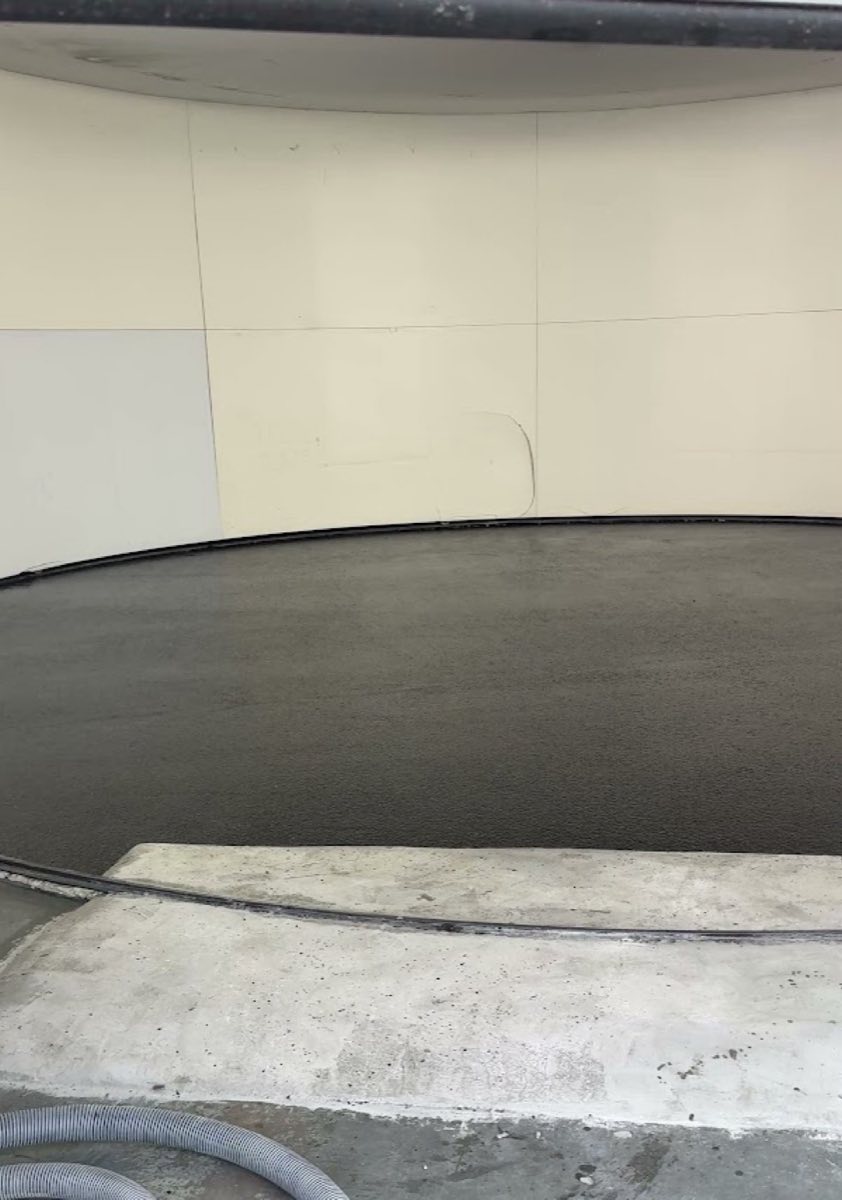
Coved bases fix most of it. The coating turns up the wall in a smooth curve, so a spill meets resin instead of a seam. Around drums and charging stations we add containment edges, a raised lip that holds a leak inside a defined area until someone cleans it up.
Door thresholds deserve the same thought. A storage room that drains toward the hallway will push a spill straight under the door and onto whatever floor sits outside it. A small curb or a slight change in the coating at that line keeps the problem inside the room built to handle it.
Joints and Drains
Saw-cut joints and floor drains are the other weak points. Joints get filled with a compatible material before the topcoat so nothing tracks down into the slab, and the coating is carried into the drain body instead of stopping short at the grate, where it would leave a ring of exposed concrete.
Prep and Timing Around a Working Operation
None of the chemistry matters on a slab that was never opened up. We diamond-grind the concrete, repair cracks and take a moisture reading before any resin goes down, because a coating on a damp or sealed slab lets go no matter how good the product is. If the grinder turns up oil soaked deep into the concrete near a lift or a drum rack, that area gets extra work before anything is coated. Our concrete grinding page explains what that prep looks like.
Then there is the business that has to keep running. Chemical rooms tend to be small, so we often take them one at a time, move the stored product to a covered corner of another area, and hand the room back once the system has cured enough for its load. You get that return date at the walkthrough, based on the room, the humidity that week and what has to roll back in.
Diego walks these rooms himself and reads the binder with you. Have it handy at the walkthrough, or call (786) 488-5057 and tell us what the shop stores.
Questions From the Walkthrough
Do you need copies of every Safety Data Sheet in the building?
No. We only need the sheets for products that get opened, poured, mixed or charged somewhere they could reach the floor. Sealed stock that never leaves its box can stay off the list. Having the binder on hand during the walkthrough saves a second visit, because the answer to most of our questions is sitting on a shelf nearby.
What about the doorway between the chemical room and the hallway?
That line gets planned on the walkthrough. If the room drains toward the hall, a spill heads straight for the threshold and the floor outside it. We look at the slope, then add a low curb or turn the coating up at the door so whatever spills in the room stays in the room.
What happens if you find a chemical no coating can handle?
Then we tell you before anything is installed. A few products are aggressive enough that a floor coating alone is the wrong answer, and the fix becomes containment: a spill tray, a dedicated cabinet, a curbed area. Changing the plan at the walkthrough costs far less than replacing a floor that was asked to do the impossible.
A chemical floor is the one coating where guessing gets expensive. Read the sheets, find the spill points, pick the system that matches both, then prep the slab properly. Done in that order, the room stays sealed and the work in it keeps moving.
Bring the binder to the walkthrough.
Photos of the room, the products it stores and rough square footage. Hialeah Gardens and Miami-Dade County.
Share your SDS binder → Call (786) 488-5057