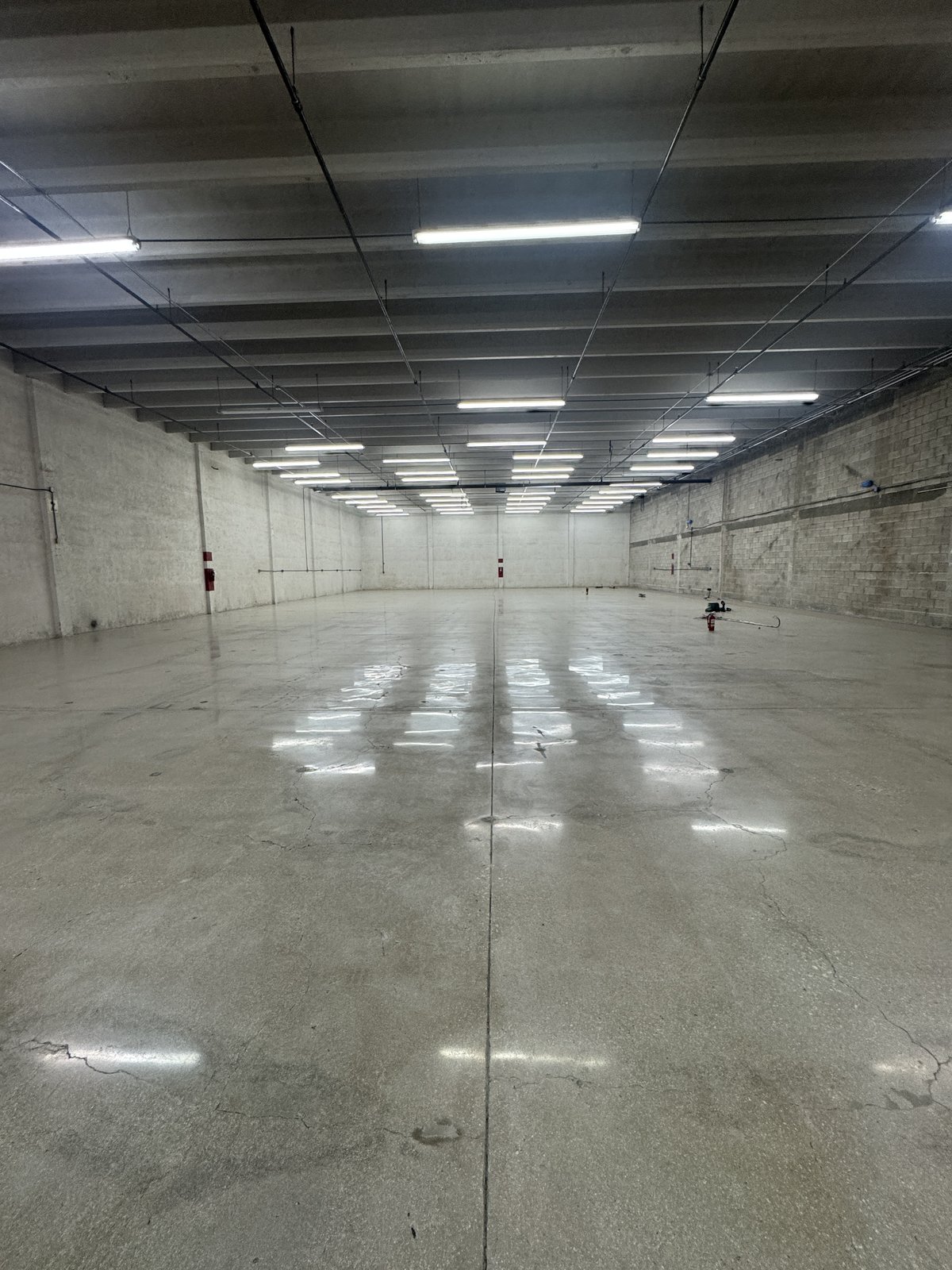
A polished concrete floor needs no wax, no topcoat and no stripping. It needs grit kept off it, the right scrubber pad, a neutral cleaner mixed at the label rate, and a pass with a burnisher when a busy lane starts to haze. Most warehouse floors that lose their shine lose it to dirt and the wrong chemistry rather than to age. This is the routine we hand Hialeah Gardens facility managers when the polishing crew packs up. Call (786) 488-5057.
What Shine Actually Is on Concrete
Polished concrete has no film on top. The shine comes from the slab itself, ground through a sequence of finer and finer diamonds until the surface is flat enough to reflect light, then hardened with a densifier and finished with a guard that resists staining. Nothing sits on the floor waiting to wear off.
That changes how the floor should be cleaned. Products made for vinyl tile or coated floors assume there is a finish to protect or to strip. On polished concrete they either leave residue that dulls the surface or chew at the guard. A warehouse that switches cleaners because the janitorial contract changed can watch its floor go flat within a few months, and the polish usually takes the blame.
The routine itself is short. Almost all of it comes down to keeping abrasive grit off the slab and washing it with chemistry that leaves nothing behind.
Grit Is the Problem Under Every Wheel
Sand and grit act like sandpaper. A pallet jack or forklift wheel rolling across a scattering of it grinds the particles into the surface, and the fine scratches scatter light. That is the gray haze you see down a drive lane while the floor under the racking still shines like the day it was finished.
The fix is boring and it works. Dust-mop the drive lanes daily, more often near dock doors where trucks track sand in. Walk-off mats at the personnel doors catch what boots carry. If a roll-up stays open for receiving through the afternoon, the first stretch of floor inside it deserves its own sweep before the scrubber ever comes through.
Spills matter as well. Oil, soda and leaking cleaning product should be wiped when they happen. The guard buys time against staining, and that time runs out; a puddle left over a long weekend can still leave a mark.
Forklift tires leave their own trail. Black scuffs from cushion tires usually lift with the daily scrub, and a stubborn one comes off with a clean white pad by hand. Resist the urge to attack it with a solvent from the maintenance shelf, which can take the guard off along with the mark and leave a dull ghost of the scuff.
The Daily Scrub, Done Right
For most warehouses an auto-scrubber is the right daily tool. Run it with a neutral cleaner at the dilution printed on the label, fitted with a pad or brush meant for polished concrete. Aggressive pads and stripping pads exist to remove finish from other floor types, and on a polished slab they only cut haze into it.
Concentration is where most crews slip. More soap does not clean better. It leaves a film that holds dirt, and the floor looks dull an hour after it was washed. If the lanes look streaky after scrubbing, try less cleaner before reaching for anything stronger, and check that the recovery tank is being emptied and rinsed.
What to Keep Off the Floor
Acidic cleaners, citrus degreasers sold for kitchens, bleach mixes and anything labeled as a stripper. Wax and acrylic floor finish do not belong on polished concrete either. They look bright for a week, then trap scuffs and grime that take a grinder to remove.
When to Bring Out the Burnisher
Even with good daily care, a busy lane gives up some gloss over time. A high-speed burnisher running a diamond-impregnated pad brings it back by polishing the surface again at a very fine level. It is a dry maintenance step that your own crew can learn or that we can handle, and the lane goes back into use once the machine moves on.
How often depends on traffic. The lane in front of a busy dock needs it long before a quiet storage aisle does. Watch the reflection of the overhead lights: when the tube lights look blurry in one lane and crisp in the aisle beside it, that lane is due.
If burnishing no longer brings the gloss back, the scratches have gone deeper than the pad can reach. That is the point for a light regrind, a few passes of finer diamonds over the worn area, which is far less work than the original polish.
Planning Care Before the Floor Is Finished
The easiest moment to set up a maintenance routine is during the job. When we polish a warehouse, we ask who cleans the floor, what equipment they already own, and which cleaner sits in the janitor closet. If the scrubber is running the wrong pads, swapping them on day one beats discovering it after the first dull patch.
We also pick the sheen level with that routine in mind. A satin finish forgives scratching in a heavy forklift lane, while a high shine shows every scuff and asks more of the cleaning crew. Our commercial concrete floor polishing page for Hialeah Gardens walks through the grind sequence, densifier, guard and joint work in detail. If an old coating has to come off the slab before any polishing starts, concrete grinding is where that job begins.
Already have a polished floor that has lost its look? Send a few photos of the lanes and the cleaning setup through our contact page, and we will tell you whether it needs a burnish, a regrind or just a different bottle of cleaner.
The crew works next to Hialeah on the weekly route. If a polished floor in your building has gone flat, call (786) 488-5057 and describe what the cleaning crew runs on it.
Floor Care Questions
Can we use the scrubber we already run on our tile floors?
Usually yes, because the machine itself is fine. What changes is the pad and the cleaner. Fit a pad made for polished concrete, switch to a neutral cleaner, and rinse the solution tank so leftover stripper or finish does not ride along. A scrubber that dulled a polished floor was almost always carrying the wrong chemistry.
Should we add a coating or wax on top for protection?
No. Polished concrete is designed to stay bare. A coating or wax adds a layer that scuffs, yellows and eventually has to be stripped, which defeats the reason you polished the slab in the first place. The densifier and guard already do the protecting. Daily dust control and a correct cleaner handle the rest of it.
How do we tell whether a dull lane needs a regrind or a burnish?
Try burnishing first. If the reflection comes back sharp, the scratches were shallow. If the lane stays hazy, or you can feel the scratches when you run a fingernail across them, they go deeper than a burnishing pad can reach, and a light regrind is the next step. We can look at it during a walkthrough.
A polished warehouse floor stays sharp because of what happens on an ordinary weekday: a sweep at the dock, a scrubber with the right pad, a cleaner mixed at the label rate. Get those habits in place early and the shine stays where we left it.
Floor gone flat?
Send photos of the dull lanes and the cleaning cart. Hialeah Gardens and Miami-Dade County.
Plan the floor care with us → Call (786) 488-5057