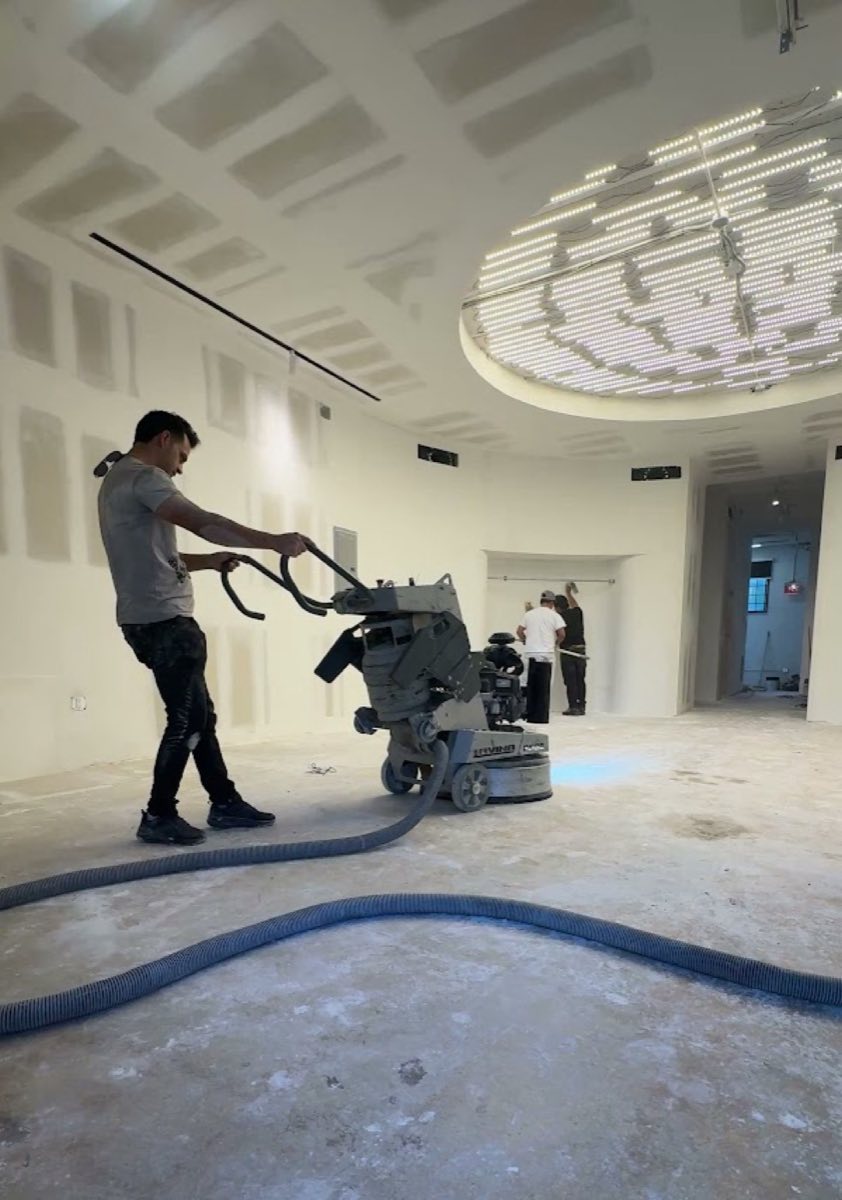
Most commercial floors we coat or polish in Hialeah Gardens already have something on them: old paint, a failed epoxy, carpet glue, thinset left from tile that came up during a buildout. All of it has to come off before the new floor goes down, and the diamond grinder does that work. What it uncovers underneath often changes the plan, which is why removal comes first and the final system gets locked in after. Call (786) 488-5057.
Why the Old Floor Cannot Stay
A new coating is only as strong as whatever it is stuck to. Put it over old paint and it bonds to the paint, which clings to the concrete with whatever adhesion it has left. When that old layer lets go, it takes the new one with it. The failure looks like the new floor peeled, though the cause was underneath the whole time.
Polish has the same problem from another angle. Polishing means cutting into the concrete itself, and diamond tooling cannot do that through a layer of glue or resin. The pads gum up, smear the residue around and leave a patchy surface that no amount of extra passes will fix.
So every job in a tenant buildout or retail shell starts with getting back to bare, sound concrete. A bare slab is the only surface we can test, repair and trust, and it is the only reliable starting point for choosing the system that follows.
Owners sometimes ask whether a new layer can simply bury the old one, especially when the existing floor looks mostly intact. Mostly intact is the problem. A coating that has lifted in one corner has usually lost grip in places nobody can see yet, and those places are exactly where the new floor will fail first.
What Comes Off, and With What
Different layers call for different tooling. Old paint and thin coatings usually come off with aggressive metal-bond diamonds on a planetary grinder. Thick epoxy and heavy mastic may need a harder cutting tool before the grinder can finish the job. Carpet glue loads up diamonds fast, so we run tooling built for it and scrape the heaviest puddles first. Thinset left from pulled tile is hard and lumpy, and it gets broken down in several passes before the slab is clear.
Where the big machine cannot reach, we work by hand. Edges along walls, corners, the base of every column and the strip under door frames get a hand grinder, so the whole room ends up at the same profile. Skip the edges and you get a new floor that peels in a neat line a few inches off every wall.
The goal at the end of removal is a uniform surface: the same clean, open concrete from one wall to the other, with nothing left that could come between the slab and the next system.
Dust Control in a Finished Buildout
Removal often lands late in a buildout, after the drywall is up, the ceiling is finished and sometimes after the lights and fixtures are in. Grinding without serious dust control in that setting means fine powder on every new surface and a cleaning bill nobody planned for.
We run the diamond grinder with HEPA dust extraction connected right at the shroud, so the dust gets pulled off the floor as it is made. The hand grinders run shrouded and vacuumed as well. That keeps the air clear enough for painters, electricians and the rest of the trades to keep working in the next room.
Sequencing helps too. Where the general contractor allows it, we like to grind before the final coat of wall paint and before trim goes on, so any stray dust lands on surfaces that still have a finish step ahead of them.
Our concrete grinding page for Hialeah Gardens covers the equipment and the surface profiles in more detail. When the space is a retail shell or back-of-house area headed for commercial flake epoxy, removal and the new floor can usually run as one continuous job.
What the Grinder Finds Underneath
Removal doubles as an inspection. Once the old floor is off, the concrete tells its own story, and it is not always the one the previous coating suggested.
Soft Spots
Some slabs have weak, dusty concrete near the surface, often from a poor finish on the day they were poured. The grinder exposes it quickly. Soft areas get ground down to harder concrete or treated before anything new goes on.
Cracks and Old Patches
Cracks hidden under paint show up clearly on bare concrete, along with old patches that never really bonded. We map them and repair them as part of the prep instead of coating over them.
Moisture
A coating that failed by bubbling or lifting often failed because vapor was coming up through the slab. With the floor bare we take a moisture meter reading, and if it runs high the plan changes to include a moisture-tolerant primer.
Matching the Surface to What Comes Next
The last part of grinding is leaving the right surface for the next step. A coating needs tooth, a rough profile the resin can grab, so the grind stops at a coarser grit. A polish needs the opposite: a flat cut that each round of finer diamonds can refine. Same machine, different finish line.
That is why we like knowing the final system before removal starts, and why the answer sometimes changes partway through. A slab that turns out too soft or uneven for a high-shine polish might be better served by a coating. A room planned for floor paint might reveal concrete good enough to polish.
Send photos of the existing floor through the contact page, with a note about what is on it now and what the space will become, and we will set up a walkthrough with a test patch.
We do not hand removal to a subcontractor. The crew that grinds the old floor off is the same crew that puts the new one down. Call (786) 488-5057 to talk through a buildout schedule.
Removal Questions
Can you take the old coating off and leave bare concrete?
Yes. Some landlords want the slab cleaned back to concrete for the next tenant. We can grind it clean and stop there, though bare concrete in a working space sheds dust over time. A densifier or a simple seal is usually worth adding so the slab does not powder onto shelving and stock once the room is in use.
How do you know what the old coating is made of?
Often we do not until we grind a test area. Paint, epoxy, urethane and clear sealers can look alike from standing height. A small patch during the walkthrough shows how the layer behaves under the diamonds, which tells us what tooling to bring and how long removal should take. It also reveals whether there is more than one layer.
Does removal damage the concrete underneath?
Grinding takes off a thin top skin of concrete along with the old floor, and that is intentional, because it opens the surface so the new system can bond. On a sound slab that is all it does. Where the slab was weak to begin with, the grinder exposes the weakness, and we repair it rather than hide it again.
Getting an old floor off is the part of the job nobody photographs, and it decides whether the new one lasts. Take it down to sound concrete, read what you find, and only then commit to the system.
Something already on the slab?
Photos of the old floor, your best guess at what it is, and what the space becomes next. Hialeah Gardens and Miami-Dade County.
Tell us what is on the slab → Call (786) 488-5057