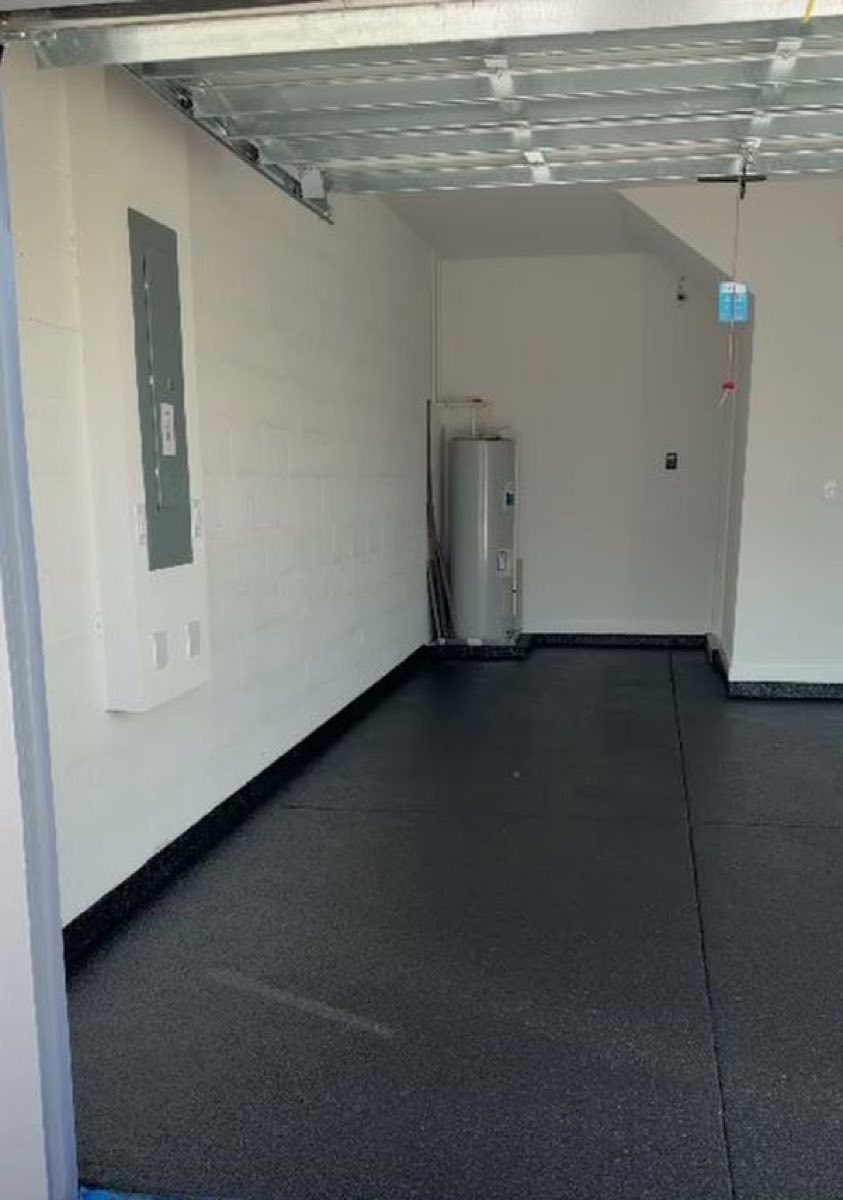
From June through November your Miami garage stops being a garage and becomes the staging room for the whole house. Fuel cans, shutters, patio furniture and standing water all land on that slab in one afternoon. A sealed floor turns storm week into a hose-out. Bare concrete turns it into permanent stains.
What Actually Happens in That Room During Storm Week
Every Miami homeowner has run this drill. The cone shifts west, the forecast firms up, and within about six hours the garage absorbs everything that was outside. Aluminum shutter panels come down off the racks and get dragged across the floor. Patio furniture, the grill, the potted plants and the kids’ bikes all get stacked wherever they fit. Two or three gas cans go in a corner for the generator, plus the generator itself. Cases of water go against the wall. Somebody’s truck gets parked inside instead of the driveway.
Nobody is being careful. That is the whole point of the exercise. You are moving fast because the wind is coming, and the floor takes every bit of it. We have coated garages in Coconut Grove where the owner could point at each mark and name the storm it came from.
The Three Things That Mark Bare Concrete
Fuel is the first one. Gas cans get filled in a hurry, they get topped off, and they drip. Small engine fuel with ethanol in it soaks straight into open concrete and leaves a dark halo you cannot scrub out, because the stain is not on the slab, it is in the slab. Generator oil does the same thing and does it worse.
Metal is the second. Accordion and panel shutters are heavy, they have sharp bottom edges, and they get dropped and dragged. Aluminum against unsealed concrete leaves grey smears that read almost like pencil, and the drag itself chips the surface paste. Once that top layer is broken, everything that lands on it after gets in easier.
Water is the third and the sneakiest. It comes in on the truck, on shoes, on furniture that was already soaked, and on the shutters themselves. It pools around whatever is stacked on the slab and it sits there for a day or two because the door stays shut. Standing water on bare concrete pulls dirt down into the pores and, on the wrong side of the house, starts a dark map of every place a box was sitting.
A Coated Slab Turns Storm Week Into a Hose-Out
Our polyaspartic wear coat handles the chemical side of this without drama, which matters because the stuff living in a Florida garage in September is not gentle: gasoline, two-cycle mix, chlorine for the pool, and whatever leaked out of the cooler. It also handles the scraping better than people expect. Set a shutter panel down on a coated floor and it slides instead of biting.
The Storage Load Nobody Plans For
Preparation gets talked about like it is a checklist, and it is really a weight problem. All the outdoor square footage of a house compresses into one room for a week. Homes off Coral Way with a narrow one-car garage feel this the hardest, because the shutters alone eat a wall and there is nowhere left to walk.
What that means for the floor is concentrated point loads in places the slab has never carried them: a stack of pavers on one corner, a full generator in another, dollies rolling across the middle. Coating does not change what the slab can carry, but it does keep the surface from spalling where a heavy metal foot has been grinding in one spot for days. That is a real failure mode on bare garage concrete and it shows up as a shallow crater you notice in November.
Why We Would Rather Coat You in the Dry Months
Here is the part most people find out too late. Wet season is the worst time to install a coating and the exact time everybody wants one.
South Florida sits on a high water table, and from June through October the ground under your slab is saturated. Heat drives that ground moisture up through the concrete as vapor. Coatings fail when vapor pressure pushes them off from underneath, so we moisture-test every slab before we give you a price, and in the wet months the readings run higher. That does not mean we cannot install. It means the primer system has to be matched to the reading, sometimes with a full epoxy vapor barrier, and that changes the job.
What Post-Storm Cleanup Actually Looks Like
The days after are worse than the storm for the floor. Everything that got dragged in wet gets dragged back out wetter, usually with sand and leaf litter stuck to it. If a branch came through a window, glass and grit end up underfoot and get ground into the surface by the same traffic that is trying to clean it up. If the power is out, the door is open and the garage is now a workshop, a charging station, and the place where the wet rugs are drying.
One more thing worth saying plainly. If your garage floods, a coating is not waterproofing and we will not pretend otherwise. What it does is keep the water from getting into the concrete and keep whatever the water was carrying from staining it. That is a much bigger difference than it sounds like when the water goes back down.
Time It Before the Cone Shows Up
A standard residential garage is a two-to-three-day job for us, start to finish, and you need the room empty for it. That is easy in March. It is impossible in the third week of August when the room is already full and the forecast is live. Every year we get calls in early September from people who want it done this week, and the answer is usually that we can grind and prep once the room is clear, which is not the week they were hoping for.
If you are in Little Havana, the Grove, or anywhere in the county with a garage you rely on when the weather turns, the move is to schedule it out of season. See what a finished floor looks like in our project gallery, then read up on what the full install involves on our Miami garage floor epoxy page or our broader Miami service page.
Send us photos and your square footage and we will tell you what the floor needs. Book a walk-through or call (786) 488-5057 and we will get you a real quote.
Hurricane Season Garage FAQ
Will a coated floor stain if a gas can leaks on it during the storm?
No, as long as you clean it up within a reasonable window. A polyaspartic topcoat is non-porous, so fuel sits on the surface instead of soaking into the concrete. Wipe it and the floor looks the same as it did before.
Can you install a garage floor during hurricane season?
Yes, we install year-round. Wet-season slabs read higher on moisture, so we test first and match the primer to the reading, sometimes with a vapor barrier. If your timing is flexible, the dry months give you a cleaner and faster install.
Does the coating hold up to dragging shutter panels across it?
It handles it far better than bare concrete. Metal tends to slide on a sealed surface rather than bite into it. A dropped panel corner can still mark any floor, which is why we keep a topcoat refresh available instead of a full redo.
Is a coating the same as waterproofing my garage?
No, and we will not sell it that way. A coating seals the concrete against absorption and staining. It does not stop water from entering the room. What it does is make the cleanup afterward simple instead of permanent.
Got a slab? Let’s pour it right.
Photo plus square footage equals a real quote in 24 hours. Serving Miami and Miami-Dade.
Resurface My Floor → Call (786) 488-5057