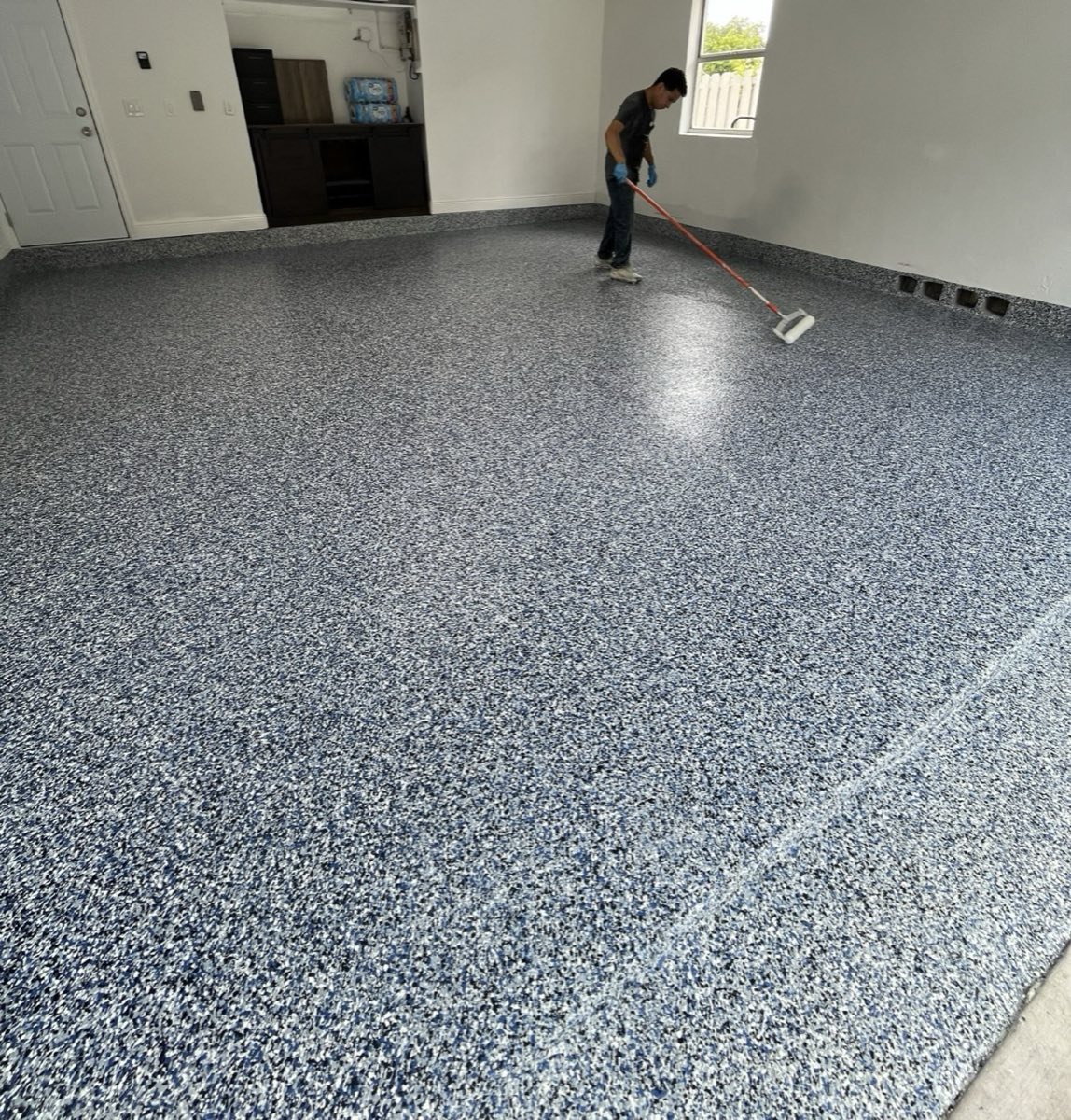
Two bids on the same Hialeah garage can differ by a wide margin and both be honest, because they are not describing the same job. The higher one usually includes diamond grinding the slab, and the lower one usually includes acid or a wash. Grinding removes material and creates a real profile for the coating to key into. Acid dissolves paste, leaves residue, and does nothing to old paint. Most of what you pay a floor crew for happens before any color goes down. Call (786) 488-5057.
Reading Two Bids That Are Not for the Same Work
The most common call we get is from somebody holding two proposals with a large gap between them and no way to tell what accounts for it. Both say epoxy. Both name a color. One is a lot cheaper, and the natural conclusion is that the expensive crew is padding.
Occasionally that is true. Far more often the gap is sitting in a line that reads like a formality. One proposal says the slab will be mechanically ground, and the other says it will be cleaned and prepared, or etched and prepared, or simply prepped for coating. Those phrases sound interchangeable to somebody who has never watched either happen. They describe fundamentally different amounts of labor, equipment, and time.
Grinding a two-car garage takes a real machine, real diamond tooling that wears out and gets replaced, a vacuum system, and hours of methodical work including the edges and corners a walk-behind cannot reach. Etching takes a jug, a broom, and a rinse. The finished floors can look identical on the day of the pour, which is precisely why this is the easiest corner in the trade to cut without anyone noticing until much later.
What a Diamond Grind Physically Does
A grinder with diamond segments abrades the top layer of the slab away. It takes off the smooth troweled skin, along with old sealers, garage paint, thin-set, adhesive residue and whatever else accumulated over the decades, and it exposes fresh concrete underneath with an open, textured surface.
That texture is the entire point. Under magnification a ground slab has peaks, valleys and open pores, and when primer is applied it flows down into all of that and cures in place. The bond is no longer just chemical attraction between two flat surfaces. It is material physically locked into relief, which is a much harder thing to pull apart.
Grinding also flattens. A slab with a high spot from a bad screed pass or a lip at an old patch gets knocked down, so the finished floor reads flat rather than telegraphing every irregularity through a thin film. And it exposes what was hiding: cracks the paint was bridging, soft spots, previous repairs. Finding those on grind day means they get addressed. Finding them after the coating is down means a callback.
Dust Control Is Not Optional
Grinding concrete generates fine silica dust that is genuinely hazardous to breathe and impossible to clean out of a house once it gets in. The work runs under vacuum extraction with shrouded equipment, which is part of what the labor line covers and part of why it takes as long as it does.
The Edges Take the Longest
A walk-behind machine cannot reach the last few inches against a wall, so perimeters and corners get worked by hand with smaller tools. On a garage with a lot of interior walls, that hand work can eat as much time as the open floor did.
What Acid Etching Does, and Does Not Do
Acid etching uses a diluted acid to chemically attack the cement paste at the surface, dissolving some of it and leaving the harder aggregate slightly proud. It does roughen a bare, clean, uncoated slab, and there are narrow situations where it is a defensible choice on new concrete with nothing on it.
The problems start with everything it cannot touch. Acid has no effect on old paint, on a previous coating, on a curing compound, or on adhesive residue. It runs right over them. So on a floor with any history, etching produces a slab that has been chemically attacked in the bare patches and left completely untouched everywhere something was covering it, which is close to the worst possible outcome: an inconsistent surface that nobody can see is inconsistent.
Then there is the residue. The reaction leaves salts behind in the pores, and rinsing them out completely is difficult and often done incompletely because it is tedious and the crew wants to get to the coating. Whatever remains sits between your primer and your concrete as a powdery interlayer, which is not what you want a floor bonded to. Neutralizing and drying properly also takes time that the schedule rarely allows for.
The Steps Between Grinding and Color
People picture a floor job as prep and then coating, two steps. In practice the middle is crowded, and the middle is where the durability lives.
After the grind, cracks get chased open with a blade so they are a clean channel rather than a hairline, then filled with a rigid repair material that will not simply crack again along the same line. Control joints get evaluated and treated according to whether they still need to move. Pitting, spalling and the craters left where old anchors were pulled get filled and leveled. Then the whole floor gets vacuumed thoroughly, because dust left in a pore is the same problem as etching residue by a different route.
Only after all of that does anything wet go down, and the first wet thing is primer, chosen based on what the moisture reading said about the slab. The color layer people actually care about is the last thing to happen and the fastest part of the schedule. That inversion is what makes floor work hard to sell honestly: the visible part is quick, and the part that determines whether it lasts is invisible by the time you see the floor.
Why This Matters More on Older Hialeah Concrete
This city runs on older buildings. Housing from the 1960s through the 1980s, plus a dense stock of small industrial units, warehouse bays, auto shops and food operations working out of buildings that have been repurposed more than once. Very few of those slabs are virgin concrete.
What we walk onto instead is a floor with layers of history: a coating somebody rolled on in the nineties, a patched trench where a line was run, adhesive from tile that came up, oil driven deep into an unsealed surface near a bay door. An etch does effectively nothing against that list. A grind removes it and leaves you standing on the actual slab, which is the only surface anyone can honestly write a system for.
It is also the only way to get a truthful moisture reading, because old sealers and paint partially block vapor and flatter the number. Grind first, then read the concrete, then choose the primer. That sequence is why prep and testing are one conversation rather than two, whether the finish ends up being a garage floor system or a poured metallic finish in a room meant to be looked at.
Diego spent his first years in marble, where nobody argues about whether preparation matters because the stone shows you immediately. Ten years later that is still the standard applied to a Hialeah slab. Ask what your floor actually needs through the contact page, or call (786) 488-5057 and we will come read it.
Prep Questions
Is etching ever acceptable?
On genuinely bare, clean, uncoated new concrete it is a defensible choice for some thin systems. That describes almost none of the floors in this city. Once a slab has any coating, sealer or adhesive history, etching leaves the real obstacles exactly where they were.
How do I tell from a proposal which one I am getting?
Ask directly whether the slab will be mechanically ground with diamond tooling under vacuum extraction, and ask what happens to the existing coating. A crew that grinds will answer immediately and in detail. Vague language about surface preparation usually means something other than grinding.
Will grinding make a mess of my house?
Not when it is run correctly. The equipment is shrouded and connected to vacuum extraction, so the dust is captured at the tool rather than released into the room. Anyone grinding concrete without extraction is creating a health problem as well as a cleanup problem.
Does grinding fix cracks by itself?
No. It exposes them honestly, which is the useful part. Cracks then get chased open and filled as a separate step before priming, because a crack left alone will reappear through the finished floor along the same line.
How long does prep take on a normal garage?
Usually the bulk of the first day, sometimes more if there is a stubborn old coating or extensive repair work. The coating itself goes fast. That ratio surprises people, and it is the most honest description of what a floor job actually is.
Can you grind a floor while my shop stays open?
Often yes, by working in sections and running the noisy work outside your busiest hours. Commercial floors get scheduled around production rather than the other way around, and the phasing plan is part of the quote.
Want to know which bid is the real one?
Send a photo and rough square footage for a quote that names the prep. Hialeah and all of Miami-Dade County.
Resurface My Floor → Call (786) 488-5057