Homestead garage floors, brought back.
Roll-on kits peeling at the door line, oil soaked deep into the slab from trucks and workshop use, tire marks that pulled the coating right off. We grind all of it away to sound concrete, repair what sits underneath, and put down a system that can take a Florida garage.
- Service
- Garage floor restoration
- Removes
- Failed coatings, fluid stains
- Repairs
- Cracks, spalls, joints
- New floor
- Flake or polyaspartic
- Moisture
- Read before we recoat
- Quote
- (786) 488-5057
Why the first coat let go.
Most garages we restore in Homestead were coated once already, usually with a hardware store roll-on kit or a thin epoxy put down over a weekend. The trouble shows up in the same places every time. Flaking starts at the door line, where sun, rain and grit reach the floor first. Pale patches open under the tires, because hot rubber softens a thin coat and tears it off the slab as the car backs out. Oil and transmission fluid find a chip and creep underneath, so the coating lifts in a widening ring around the leak.
None of that means the concrete is bad. Under a failed kit the slab is usually fine. The coating gave up because it sat on a smooth, sealed or dirty surface and never had anything to grip. Paint and thin epoxy need an open, sanded profile to bond, and a garage that was only washed and rolled never gets one.
Newer homes out here tend to come with bigger garages, and plenty of them double as workshops with a compressor, a welder or a pickup that drips. That use is harder on a floor than a sedan parked overnight, so we ask what really happens in the space before we pick a system.
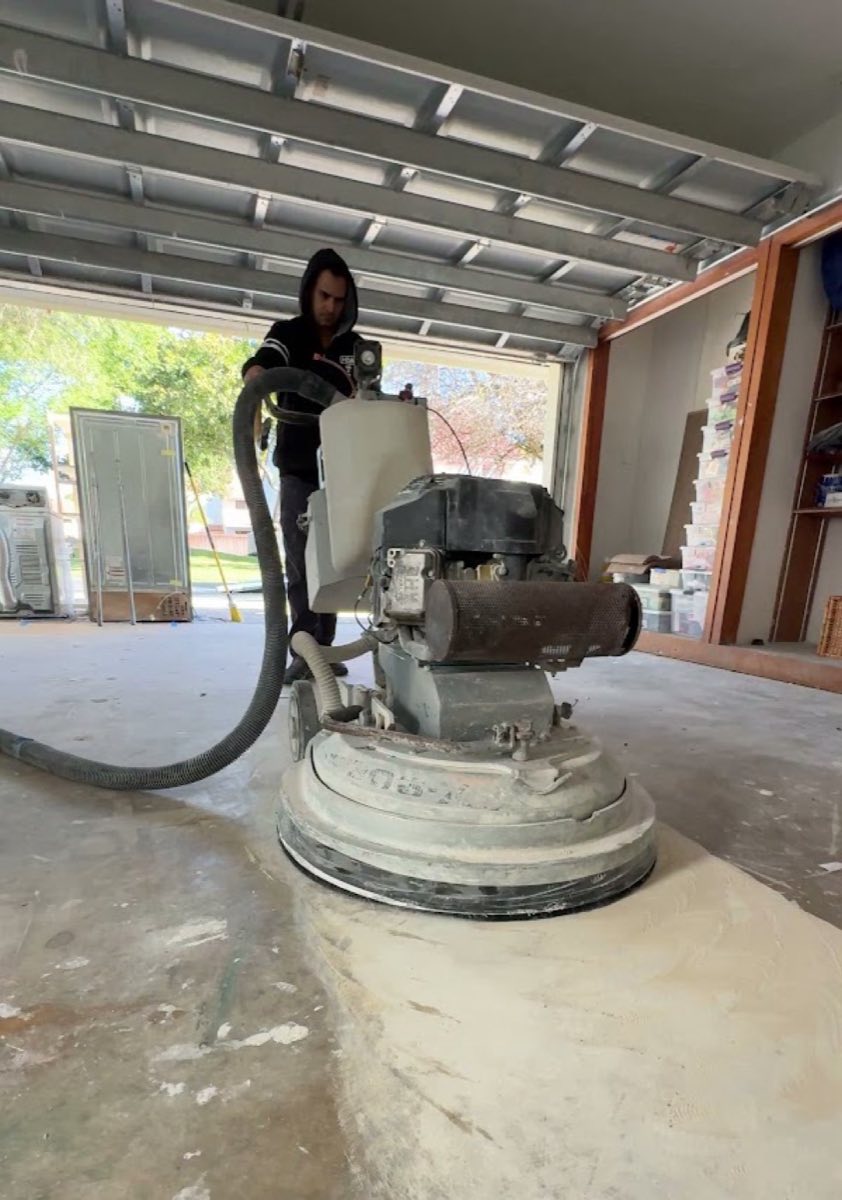
Restoration means the old coat comes off completely. A patch over a peeling floor lasts a few months at best, since the new layer can only hold as well as the failing one beneath it. Grinding down to bare concrete gives the replacement the same footing a fresh slab would have.
Failed garage coatings, ground off where they sit.
The crew that grinds off your old coating is the same crew that lays the new one, because every job stays in-house with no subcontractors. A garage walkthrough in Homestead usually happens within the week you call. Restored garages and workshops are in the project gallery, and our Homestead page lists the other systems we install in town.
At the walkthrough we bring a moisture meter and sample panels of flake blends and solid colors, so you can choose against your own walls and cabinets. On grinding day the machine runs with HEPA dust extraction, which keeps the fine powder from an old coating out of the house, the car and the yard. If the garage opens straight into a kitchen or laundry room, say so and we will seal that door before we start.
Stains, spalls and cracks get fixed first.
The grinder takes the coating off. What it uncovers decides how much repair the slab needs before anything new goes on top.
Oil and fluid stains
Fluids that slipped through a failed coat sit in the top of the concrete. We grind past the worst of it and degrease what remains, because resin will not hold onto oil, however good the product is.
Cracks and control joints
Hairline cracks get chased open and filled so they do not show through the new finish. Control joints are cleaned out, then filled or kept open depending on whether the slab is still moving.
Spalls and pitting
Where the surface has popped or crumbled, usually near the door or under a drip, we cut back to firm concrete, rebuild with repair mortar and grind it flush with the floor around it.
Choosing what goes back down.
Once the slab is clean and repaired, it is a blank. The system that goes on next depends on how you use the garage.
Polyaspartic flake for daily parking
A full broadcast of color flake in a polyaspartic base, locked in with a clear topcoat. The flake hides dust and light scuffs, and the polyaspartic keeps its color with the door open in afternoon sun.
A heavier build on the workshop side
Where a bench, a welder or a set of jack stands lives, we add thickness and a harder topcoat so dropped tools and rolling equipment do not chip through to concrete.
Texture at the wet entry
Rain driven in under the door makes a smooth coating slick. A fine aggregate in the topcoat across the first few feet keeps that stretch walkable in wet shoes.
Solid color for oversized garages
On a big three-bay floor or a detached shop, some owners want one clean color with a light flake scatter. It reads calmer across a large slab and is easy to touch up later.
When restoring is the wrong call.
We would rather tell you up front than coat a slab that will fail a second time. A few conditions sit outside what grinding and resin can solve. A floor that has heaved or sunk in sections, with raised edges that catch a tire, has a problem in the base under the concrete. Wide cracks that keep growing from one season to the next usually point the same way.
Moisture is the other limit. Our moisture meter tells us how much vapor is rising through the slab. A high reading does not always end the job, since some primers are made for damp concrete, but it changes the system we recommend, and sometimes the right answer is to wait or fix drainage outside the garage first.
Most Homestead garages land well inside what we can restore. When one does not, we explain what we found at the walkthrough and what it would take. Every step from removal to topcoat is covered on our garage floor restoration page.
- Peeling kit coating
- Restore
- Oil-soaked slab
- Restore after degreasing
- Hairline cracks
- Restore
- Heaved sections
- Slab repair first
- High moisture
- Different primer or wait
How an old garage floor comes back.
Look and measure
Free walkthrough. We test how well the old coating holds, read the slab for moisture and talk about how the garage gets used.
Strip and grind
Diamond grinding under HEPA dust extraction takes the failed coating off and opens up the concrete beneath it.
Repair
Stains degreased, cracks chased and filled, spalls rebuilt and ground flush so the slab reads as one surface.
Coat and hand back
Base coat, flake or color, clear topcoat, then a last look with you before cars and tools move back in.
Other Homestead floor work in this set.
Restoration is one of five services we wrote up for Homestead. If your project leans another direction, start with one of these.
Garage owners ask us these first.
Can you coat over the peeling floor I have now?
No. A coating that is lifting in one spot has a weak bond across the whole floor, and anything rolled over it fails right along with it. We grind the old material off to bare concrete so the new system bonds to the slab itself, which is the only footing that lasts.
Will the oil stains show through the new floor?
Usually not. We grind through the stained top layer and degrease whatever is left. A flake broadcast or a solid color base covers any faint shadow that remains. The bigger risk with oil is adhesion, which is why the cleaning matters more than the color you choose.
Will hot tires pull up the new floor the way they did the old one?
Not when it is bonded to ground concrete. Hot tire lift happens when soft rubber grabs a thin coat that was only stuck to a smooth or sealed surface. We grind the slab open, build the new system thicker than a roll-on kit, and finish with a topcoat made to take tire heat, so the rubber has nothing weak to pull on.
Can a workshop floor take the same system as the parking side?
It can, though we often build it thicker. Rolling toolboxes, jack stands and dropped steel are harder on a coating than parked tires. We look at where the bench and heavy equipment sit, then plan extra thickness and a tougher topcoat for that part of the floor.
How do I get a quote before anyone visits?
Send a photo of the floor and the rough square footage. We come back with a quote within 24 hours, then confirm it at a free walkthrough, usually within the same week, once we have tested the old coating and taken a moisture reading on the slab.
Let’s see what is under the old coat.
Take a few photos of the worst spots, the door line and any oil stains, and send them with the rough size of the garage. We answer with a quote inside 24 hours. After that, Diego or someone from the crew visits to test the old coat and meter the concrete. Rather talk it over first? Call (786) 488-5057 or reach us through the contact form.