Kendall balconies get the leak traced before the membrane goes down.
When a balcony leaks, the first sign usually turns up in the unit below or along the bottom of the door, well before anything looks wrong on top. We find where the water gets in, close that path, and then build a urethane membrane in layers with a textured surface you can walk on. The HOA paperwork comes with the quote: a signed proposal, our insurance certificate and the material spec sheets, set up for board review.
- Trace
- Sill, rail posts, drain, edge
- Readings
- Moisture meter under the old finish
- Board packet
- Proposal, insurance, spec sheets
- System
- Layered urethane, textured top
- Quote
- (786) 488-5057
A balcony is a roof over someone else’s ceiling.
Kendall has fewer towers than the beach, but it has plenty of condos and townhomes, and their balconies do a job most owners never think about. That slab is the roof for whatever sits beneath it, whether that is a neighbor’s living room, a covered entry or a parking space. Water that gets through rarely drips straight down. It runs along the concrete, finds a crack or a gap, and shows up somewhere that makes the source hard to place.
That is why we trace before we price. Rolling a coating over a balcony that is still taking water at the sill only moves the problem a few feet. We look at the slab, the joint where it meets the wall, each railing post, the drain and the outer edge, and we take moisture readings so we know how wet the concrete is under the old finish.
The corner that causes more trouble than any other is the line where the walking surface runs up to a sliding door and its threshold. A membrane has to turn that corner and seal against the frame without leaving a gap behind the trim. Getting that detail right takes patience, and it is the part of a balcony we refuse to rush.
Our own installers handle every stage, so the person who traces your leak is on the crew that lays your membrane.
Condo and townhome balconies, handled by our own installers.
Our Kendall balcony work sits mostly inside gated communities and HOA-run condo buildings, alongside the family garages and back patios that fill the rest of the suburb’s schedule. None of it goes to a subcontractor. A walkthrough usually happens within the same week you call, and photos of finished work are in the project gallery. Everything else we install around here is listed on our Kendall page.
What the HOA board wants on the table.
Balcony work in a managed community needs board approval before anyone touches the slab. We assemble the packet alongside the quote, so it can go straight onto the next meeting agenda without a second round of requests.
Signed proposal
Scope, system, the repairs we found and the order we will work in, written so a board member who has never stood on that balcony can follow it. It carries our signature, so the board knows exactly what it is voting to approve.
Insurance certificate
Management companies usually want proof of coverage on file before a crew enters the building. The certificate travels with the packet, and if the association asks for a particular holder name, mention it when you request the quote.
Material spec sheets
The board, or whoever advises it on building work, can read exactly which membrane and topcoat are going down. The sheets are formatted for HOA review, so nobody has to dig through a manufacturer’s website to find the numbers they care about.
Four spots we check before writing a number.
Tracing a leak means looking hard at every place the slab stops being one continuous surface. These four get checked on every balcony, and each gets its own repair before the membrane goes on.
Door threshold
Water that sits against a sill gets pulled under the frame. We clean the joint out, rebuild the transition so the slab sheds water away from the door, and carry the membrane up to the frame line.
Railing posts
Every post set into the slab is a hole through the waterproofing. The old sealant at the base cracks and pulls away in the sun, so we cut it back, seal around the post and wrap the membrane up its foot.
Drain
A clogged or badly sealed drain holds water right where the balcony is supposed to empty. We clear it, check the seal at the drain body and detail the membrane down into it so runoff has one way out.
Slab edge
The open edge takes wind-driven rain and runoff from any balcony above. Chipped or cracked edges are rebuilt with repair mortar, and the membrane wraps the edge so water drips clear instead of tracking back underneath.
A membrane built in layers, finished with grip.
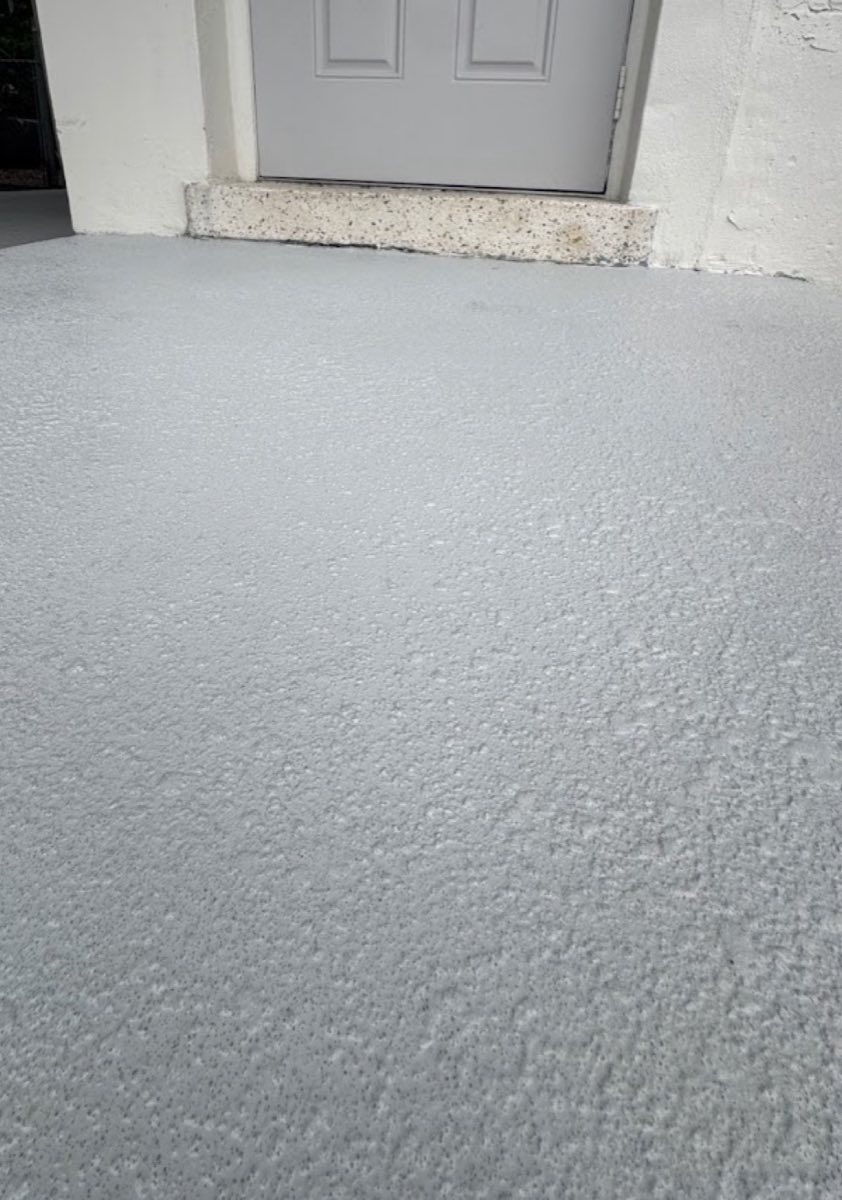
Once the leak paths are closed, the slab is ground clean so the first layer can bond to sound concrete. The system we use on balconies is a urethane membrane applied in stages: a base layer that does the waterproofing, detail work at every joint and post, then a wear layer with texture broadcast into it so the surface keeps its footing in the rain.
Urethane stays flexible, which matters on a balcony that bakes in the afternoon and cools off overnight. A rigid coating cracks right along with the concrete under it. A flexible membrane rides over that small movement and holds its seal.
Color and texture get chosen with the association’s rules in mind, since many boards want every balcony on a building to match. We bring the sample-panel kit to the walkthrough so you and the board judge a real surface in daylight. The full system, including how we handle larger terraces, is on our balcony waterproofing page.
- Prep
- Grind, clean, meter
- Details
- Sill, posts, drain, edge
- Base
- Urethane membrane
- Wear
- Textured broadcast layer
- Finish
- Matched to the building
From the first call to a dry balcony.
Trace
Moisture readings and a look at every joint, plus the ceiling below when the neighbor is willing to let us in.
Approve
Proposal, certificate and spec sheets go to management in time for the board’s next meeting.
Repair
Leak paths sealed, edges rebuilt, slab ground and vacuumed, all inside the hours the building allows.
Coat
Membrane, detail work and the textured wear layer, with the balcony kept closed until it is ready for feet.
More of the Kendall work on our schedule.
Balconies are one piece of what we do in the area. These are the other floors and outdoor slabs Kendall owners call us about.
Balcony questions from owners and boards.
Does balcony waterproofing in Kendall need a permit?
Usually not. Kendall is unincorporated, so the county is the authority, and most coating work in Miami-Dade County goes ahead without one. The approval that matters on a condo or townhome balcony is the HOA’s, which is why the board packet arrives with our quote.
What should I look for on my balcony after a heavy storm?
Check the ceiling of the space below for stains, look for water still standing a few hours later, and run a finger along the sealant at the door sill and around each railing post. A crack or gap in either spot is worth a photo, so send it to us.
Do you need to get into the unit below?
Only if tracing the leak calls for it. A stain on the ceiling underneath helps us match the water to its entry point upstairs. We ask that owner first, set the timing through management, and nearly all of the work itself happens from the balcony side.
How do you work around the building’s access rules?
We follow what management sets: working hours, elevator use, parking and where materials can be staged. Hallways and lobbies are protected on the way in and out. If the rules call for a reservation or a notice to residents, tell us at the walkthrough and we plan for it.
Can you match the other balconies on the building?
Yes. Many associations want every balcony to look the same, so we bring samples of the textured finish to the walkthrough and match the color and texture the board already approved. If the building has no standard yet, we can help the board settle on one.
Tell us which balcony is taking water.
Take one photo of the balcony floor, one of the door sill, and one of the ceiling below if a stain has shown up, then add the rough square footage. We send back a real quote inside 24 hours, and the walkthrough with the moisture meter usually lands the same week. Call (786) 488-5057, or send the photos through our contact form.