Homestead garages poured in liquid metal.
Metallic epoxy for collector-car garages, show bays and the oversized garages that come with newer homes down here. The pigment drifts and pools as the resin levels, so no two floors ever come out alike, and we settle your colors on sample panels before anything gets mixed on the slab.
- Service
- Metallic epoxy floor
- Colors
- Chosen on sample panels
- Topcoat
- UV-stable clear
- Prep
- Ground flat, low spots filled
- Moisture
- Tested before the base coat
- Quote
- (786) 488-5057
Three decisions that shape a metallic pour.
A metallic floor is part chemistry and part hand work. Most of what you see at the end comes from choices made before the first bucket is opened.
Base color
The base coat sits under the metallic and shows wherever the pigment thins out. Over black, silver and bronze read deep and dark. Over gray or white, the same pigment turns lighter and softer.
Pigment and movement
Metallic pigment is a fine, shimmering powder carried in clear resin. As the crew spreads and works it, the powder drifts, cells and pools along the strokes. How we work the coat steers it toward broad sweeps or tight marbling.
Gloss and topcoat
A high-gloss clear coat gives metallic its depth. In a garage it also has to take tire heat and the sun coming in under an open door, so the topcoat matters as much as the color does.
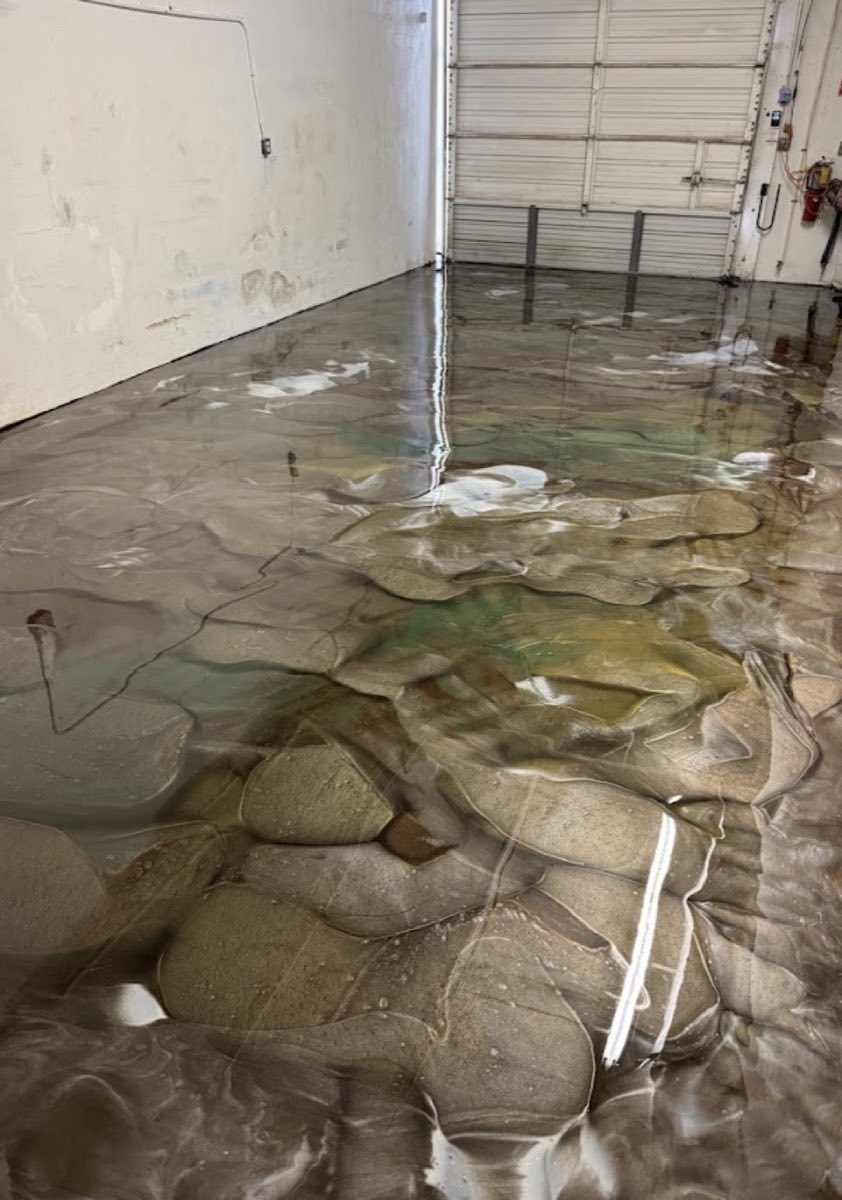
What happens while the resin levels.
Most people never see a metallic while it is still wet, and that stage decides most of the look. Once the coat is mixed and spread, the installer keeps working it while it is wet, and the pigment goes on moving after the tools stop. Light hits the metal particles differently depending on which way they settle, and that is where the deep, three-dimensional look comes from.
Because the finish depends on how the material flows, each section of a metallic floor gets built in one continuous working session. We plan seams at doorways, bay dividers or control joints, where a break looks intentional instead of accidental.
Before coatings, our crew came up polishing marble, and a metallic floor asks for the same eye. You are reading reflected light across a wide surface and adjusting by hand until the movement looks right from the doorway, which is where most people will see it first.
Metallic is far less forgiving of a rough slab than flake. Flake hides small dips and old patches. A metallic shows every one, since the resin collects in low spots and runs thin over high ones. That is why the grinding and filling take as long as they do before any base coat goes down.
Spaces where a metallic earns its place.
A metallic floor suits rooms where people stop and look. These are the requests we see from Homestead owners most.
Collector-car garages
A dark metallic under a polished car reads like a showroom, and a high gloss throws the paint back at you. We pair it with a topcoat picked to handle hot tires.
Oversized and multi-bay garages
Big floors give the pigment room to move in long sweeps. We lay out the work so seams fall where a bay divider or an existing joint already breaks the slab.
Workshops that double as a showroom
Where the car and the workbench share a building, metallic can run across the display side while a tougher flake system covers the work wall, split at a joint.
Small commercial display floors
A detailing studio, a small showroom or a front counter area can carry a metallic too, with grit added to the topcoat where customers walk in from outside.
Home gyms and hobby bays
A converted bay used for training or a hobby can take a metallic as well. Rubber mats go under the heavy equipment, so a dropped weight lands on rubber and the clear coat stays unmarked.
Metallic floors get chosen with your own lights on.
Many homes in Homestead are newer builds on bigger lots, with oversized garages and detached workshops that suit a show floor. Past metallic floors are in the gallery, and the Homestead overview shows everything else we bring to town. Every metallic we pour is ours from first grind to final clear coat, with no subcontractors on the slab, and the walkthrough, panels included, is usually booked within the week.
Before the walkthrough, look at the garage at night under the lights you actually use. Cool white LEDs make silver and blue metallics read crisp, while warmer bulbs pull bronze and copper forward. We bring panels in several base and pigment pairings, set them on your floor under that light and let you stand where you usually park.
Sun through the door, heat from the tires.
Ordinary epoxy yellows in sunlight. On a metallic floor, an amber cast wipes out the clean silver or blue you picked, and in a Homestead garage with the door up while you work in the yard, the first few feet catch plenty of strong South Florida sun.
So the metallic layer always sits under a UV-stable clear coat, typically a polyaspartic or an aliphatic urethane. That top layer takes the light and the scuffing, and it can be recoated later without disturbing the metallic underneath.
Tire heat is the second test. A car driven in off a hot road sets soft rubber on the floor, and a weak coat can lift as the tire cools. Proper prep and a topcoat suited to it prevent that. Full system details are on our metallic epoxy garage floors page.
A few habits protect the finish once it is down. Set a mat or a plywood pad under jack stands and kickstands, lift heavy toolboxes instead of dragging them, and keep a drip tray under any car that weeps oil. The clear coat handles normal daily use well. Point loads and tracked-in grit are what scratch it.
- Slab
- Ground and filled
- Primer
- Matched to the moisture reading
- Base
- Tinted to your panel
- Metallic
- Worked by hand
- Top
- UV-stable clear
Panels first, pour last.
Walkthrough and panels
We look over the slab, take a moisture reading and bring sample panels so you see the colors in your own garage light.
Grind and flatten
We grind with diamonds and a HEPA vacuum, then fill cracks and low spots so the resin levels evenly.
Base and metallic
Primer and a tinted base, then the metallic coat worked by hand until the movement looks right.
Clear coat
A UV-stable clear topcoat for gloss and protection, then one more look with you before the car rolls back in.
Not every Homestead floor should be metallic.
A busy work garage, a wet entry or a sunny patio may be better off with one of these instead.
Questions people ask before choosing metallic.
Will my floor look like the photos I have seen?
Close in color, never identical. The movement in a metallic depends on how the pigment settles on your slab, in your temperature and humidity, under our tools that day. Sample panels show you the palette and the general look. The final pattern belongs to your garage alone, and most owners end up liking that part.
Why test the slab for moisture first?
Vapor rising through concrete can push a coating loose or leave cloudy patches under a clear coat, and a metallic shows both plainly. We take a moisture meter reading at the walkthrough. If it runs high, we switch to a primer made for damp slabs or tell you the floor needs work first.
Does a metallic floor show dust and footprints?
More than a flake floor does. A dark, glossy metallic shows dust, paw prints and dried water spots the way a black car does. Mid tones and lighter bases hide more of it, so if the garage door stays open a lot, we bring a few lighter pairings to the walkthrough as well.
What happens when a metallic gets scratched or marked by tires?
Scratches and tire marks sit in the clear topcoat, not in the metallic layer under it. Fine swirls show more on a dark gloss under bright LEDs, and most tire marks come off with a pH-neutral cleaner. A deep scuff gets sanded and the clear coat is recoated across the floor or up to a joint, so the gloss stays even and the metallic is never touched.
How should I take care of it?
Dust mop or sweep often, since grit dulls a gloss topcoat faster than anything else. Wash with a pH-neutral cleaner and a soft mop, and wipe up oil or coolant when you spot it. When the gloss wears in the traffic lanes, the clear coat can be refreshed without touching the metallic.
See the colors on your own slab.
Tell us the size of the garage, send a photo or two and mention any colors you have in mind. A quote comes back within 24 hours. At the walkthrough we lay sample panels down in your garage light, meter the concrete and talk through the topcoat. Questions before then? Call (786) 488-5057 or write to us through the contact page.