Patio coatings built for Homestead’s full sun.
Pool decks, lanais and back patios take the hardest light of any surface we coat. We put down UV-stable systems that hold their color, keep their grip when they are wet, and stay kinder to bare feet when you choose a lighter shade. Every patio is tested and ground before it is coated, exactly like a floor indoors.
- Surfaces
- Patios, lanais, pool decks
- Finish
- Flake or textured
- Topcoat
- UV-stable
- Traction
- Aggregate set per surface
- Quote
- (786) 488-5057
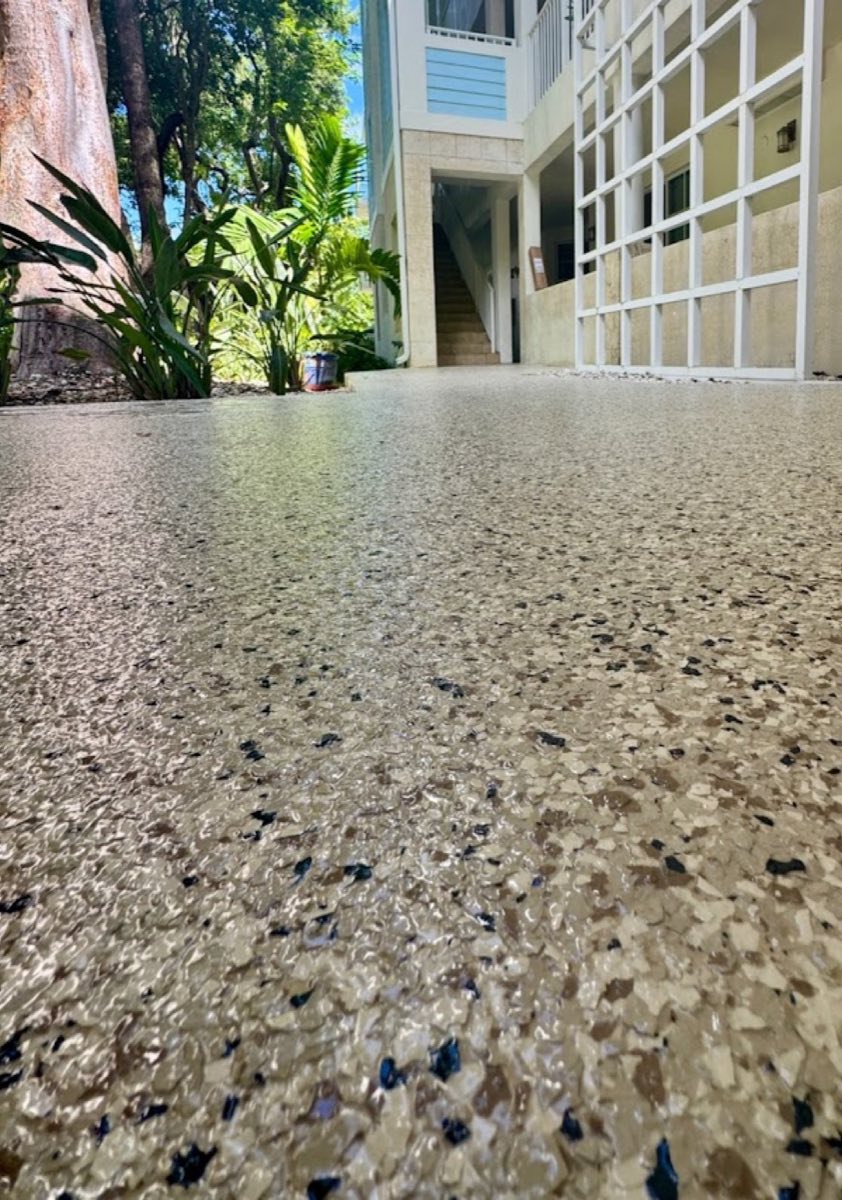
Outdoor concrete takes the worst of the weather.
A garage floor deals with tires and the odd oil drip. A patio in Homestead gets direct sun for most of the day, heat soaking into the slab, chlorinated water splashing off the pool and sudden afternoon storms, with bare feet crossing it through all of that. Products sold for garages often fail outside for exactly this reason. Standard epoxy chalks and turns yellow under UV, and once the surface starts breaking down it goes dull and rough.
So everything we put down outdoors is built around a UV-stable topcoat. It holds the color you picked and keeps the finish from going chalky in the sun. Under it, the prep matches what we do indoors: moisture readings, diamond grinding with HEPA dust extraction, and repairs to cracks and broken edges before any coating goes on.
Mixed flake blends, with three or more colors in the chip, are a common pick outside because the speckle hides dirt, leaf litter and water spots between rinses. A walkway that runs past planting beds gets more of that debris than an open deck, so we lean toward a busier blend there.
When a pool deck, a lanai and a walkway all connect, we can coat them as one continuous surface. The finish then carries from the back door to the water’s edge with no change in color or texture where one slab meets the next.
Covered lanais are a slightly easier case. The roof keeps direct sun off most of the floor, but rain still blows in along the open side, and that strip stays damp longer than the rest. We treat it like an open patio and give it the same topcoat and grip as the uncovered deck beyond it.
Pool deck and lanai work starts with a walk around the yard.
Patio walkthroughs usually land within the week, and we spend most of that visit outside, looking at sun, shade and where the water goes. A lot of the houses in Homestead are newer builds on bigger lots, where the patio, the pool deck and the lanai make up a large share of the living space, and the town sits south of Miami at the edge of the area we cover. You can see outdoor finishes in our photo gallery, or head back to the Homestead service page for the rest of what we install here.
Heat you can feel through your feet.
Surface heat is the first thing people ask about. Any slab in full sun gets warm, coated or bare. Color is the choice that changes the heat, and the finish decides how the deck looks and grips in the afternoon.
Lighter colors
Pale flake blends and light textured finishes reflect more sunlight and stay more comfortable than dark ones. When a deck runs right up to the pool, we steer people toward the light end of the color chart.
Less glare, more grip
A textured finish cuts the glare that bounces off a glossy coat at midday and gives wet feet more to hold. It does little for heat, but it hides the scuffs a patio collects from chairs, tables and heavy planters being dragged around.
Sample panels in your yard
We bring sample panels to the walkthrough and leave them out in your own sun. Standing on a few of them in the afternoon tells you more about heat and grip than a color card ever could.
Flake or texture on an outdoor floor.
Both go down over the same prep and finish under the same UV-stable topcoat. What changes is how the surface looks and how it feels underfoot.
Full-broadcast flake
Vinyl flake gets broadcast into the base coat until the surface is covered, then scraped and sealed. The mixed colors hide dirt well and the chips add some texture of their own. It suits walkways and lanais that see steady traffic.
Textured solid color
A single color with fine aggregate built into the topcoat. It reads cleaner and more modern, and it is easy to keep cool in a pale shade. It is often the choice around a pool, where bare feet matter most.
Added grip
Either system can take extra aggregate in the topcoat. We tune how coarse it is so wet feet stay planted without the surface feeling like sandpaper to anyone sitting on the pool edge.
Steps and slopes
Stairs, landings and ramps get more attention because water runs down them. We usually build more texture into those surfaces than into the flat deck around them, so the transition is where the grip increases.
Standing water is a slope problem first.
A coating is a thin layer, and it follows the shape of the slab beneath it. It cannot make water run somewhere the concrete does not already send it. If your patio has a low spot that holds a puddle after a storm, it will still hold one once it is coated, and standing water on any outdoor finish is where algae, stains and slips begin.
We look at drainage on the walkthrough. Small low spots can often be built up with repair mortar during prep. Bigger slope problems belong to a concrete contractor, and we will say so plainly instead of coating over them. We also check where downspouts, sprinkler heads and the pool’s splash zone put water, since those are the spots that stay wet longest.
Timing is the other local factor. A South Florida summer often brings a storm in the afternoon, and a fresh coating outdoors needs dry hours to set. We start early in the day, keep watching the forecast, and cover the work or move the date when rain looks certain. More on the systems themselves is on our patio coatings page.
- Slope
- Low spots marked
- Downspouts
- Where the water lands
- Pool edge
- Splash zone
- Shade
- Hot and cool areas
- Weather
- Morning starts
From the walkthrough to the first barefoot walk.
Walk and sample
We test the slab, check the drainage, and leave sample panels out in the sun so you can feel them.
Prep the deck
Pool edges and plantings get covered. Then we grind, repair cracks and broken edges, and vacuum it all clean.
Coat in the morning
Base coat, flake or texture, and the UV-stable topcoat go down early, ahead of the afternoon weather.
Hand it back
We walk the finished surface with you and explain when it is ready for feet, then for furniture.
Other Homestead floors we finish.
Patio work often leads to the garage or the workshop next. These are the other systems we install on Homestead properties, inside and out.
Patio questions we hear in Homestead.
Will a coated patio get too hot to walk on?
Any surface in full sun warms up. Color is what changes how hot it feels: a light shade stays more comfortable underfoot than a dark one, while texture makes little difference to heat. That is why we leave sample panels in your yard. Stand on them in the afternoon before you choose.
Will the color fade or yellow outside?
Our outdoor systems finish with UV-stable topcoats made to hold color in direct sun. Ordinary garage epoxy left outdoors will chalk and yellow, so we never use it as the top layer on a patio, lanai or pool deck.
Is a coated pool deck slippery when it is wet?
It does not have to be. We add aggregate to the topcoat and set how coarse it is for each surface, with more on steps and slopes. Pouring a little water on a sample panel shows you the grip before anything is coated.
Can you fix the puddle on my patio?
Small low spots can often be built up with repair mortar during prep. A coating alone will not change the slope, so larger drainage problems need concrete work first. On the walkthrough we will tell you which kind you have.
Will patio furniture and planters mark the coating?
Not if you set them down gently. Put felt or rubber pads under chair and table legs, lift heavy planters instead of dragging them, and keep a saucer under any pot so water does not sit in a ring. At the handover we tell you when the surface is ready for feet and when it can take furniture.
Tell us how you use the patio.
Snap a few photos of the patio, lanai or pool deck, add the rough square footage, and tell us who spends the most time out there. Quotes come back inside 24 hours. The walkthrough usually happens the same week, and the sample panels come with us. Call (786) 488-5057 to talk it through, or send everything through the contact form.