We polish the slab your Kendall house sits on.
Under the carpet or tile in most houses sits a concrete slab that can become the finished floor. We pull up what is left of the old flooring, grind the slab open, fill the holes it was hiding and polish it to the sheen you pick, anywhere from a soft matte to a high gloss. HEPA extraction runs on every grinder, so the dust goes into a collector and stays out of the bedrooms you are still sleeping in.
- Uncover
- Adhesive, tack strip, old patches
- Grind
- Coarse diamonds, HEPA on
- Fill
- Holes, trenches, cracks
- Polish
- Finer grits to your sheen
- Quote
- (786) 488-5057
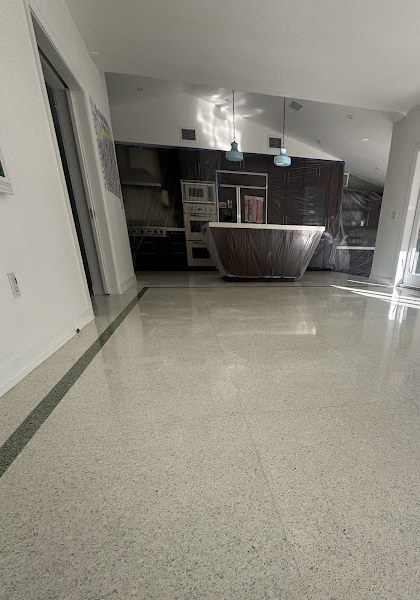
What the carpet was hiding all those years.
A house slab spends most of its life covered. Carpet sits on a pad over tack strip nailed down around every wall. Tile sits in thinset, and older tile sometimes sits in a thick mortar bed. Vinyl leaves black mastic behind when it comes up. None of it was put down with the idea that the concrete would ever show, and all of it leaves marks.
Polishing is a finish you look straight into. We remove material instead of adding a layer on top, so whatever the slab carries stays visible: the ring of nail holes along the baseboards, the trench where a plumber once replaced a drain line, a patch somebody troweled in decades ago, the faint outline of an old glue pattern. Some owners like that history in the floor. Others want it filled and toned down. Either one is a fair choice, and the time to make it is before the grinder runs.
That is why the walkthrough includes a look under a corner of the flooring when you allow it, and a sample panel on the bare slab once the old floor is out. You see your own concrete, ground and honed, at the sheen you are leaning toward.
Diego came up polishing marble, and residential concrete polishing sits much closer to stone work than to coating work. The grit sequence, the patience between passes and the eye for an even reflection across a whole room all carry straight over.
Kendall homes, worked by our own installers.
Kendall is a residential suburb southwest of Miami, made up largely of family homes with two-car and three-car garages. Inside those houses, polishing usually means a living room and kitchen, a long hallway, or the whole ground floor at once. The installers who scrape up the old adhesive are the same ones who run the last polishing pass, and no part of the job goes to a subcontractor. You can see finished floors in our project gallery, and our Kendall page lists everything else we install for homeowners here.
Choosing how much the floor should shine.
Sheen comes from the grit sequence. Each pass uses a finer diamond than the one before, and where we stop decides how much light the floor throws back. A sample panel on your slab settles the choice.
Matte
We stop at a lower grit for a soft, honed look. It shows fewer footprints and less glare in a room with big windows, and it reads closer to natural stone than to a showroom floor.
Satin
A middle sheen with a gentle reflection, where furniture and window light show up softly. It suits living areas that see shoes, pets and daily traffic, and it forgives a missed day of dust mopping.
High gloss
We carry the polish through the finest grits for a sharp, mirror-like reflection. It looks striking in an open-plan room and asks for a little more dust mopping to keep it looking that way.
Filling what the old flooring left behind.
Repairs happen after the first grinding pass opens the slab and before the polishing grits begin, so every fill gets ground and polished along with the rest of the floor.
Tack-strip holes
Carpet leaves a line of small nail holes along every wall. We clean them out and fill them with a material that takes a polish, so the line fades and stops collecting dirt.
Plumbing trenches and old patches
A replaced drain line or an old slab repair shows up as a patch of different concrete. We grind it level with the rest and decide with you whether to tone it down or leave it as part of the floor.
Cracks
Shrinkage cracks are normal in a house slab. We clean them out and fill them in a color you choose, darker to show the line plainly or closer to the concrete to quiet it.
Adhesive shadows
Mastic and carpet glue can stain into the top of the slab. Most of it comes off in the coarse grits. Where a shadow stays, we show you before polishing further, so nothing about the finished floor catches you off guard.
Polishing a house while you still live in it.
Most residential polishing happens in a home people are living in, and we plan the work that way. Before the grinder starts, we walk the house with you and agree on a room order. Furniture moves into the rooms we are not working in that day, and plastic goes up over doorways and openings into the rest of the house.
Our HEPA dust extraction runs on the big grinder in the open rooms and on the hand grinders along the walls, under the cabinet toe kicks and around door jambs. The dust goes into a collector bag. You will hear the machines during working hours, and the rest of the house stays usable while we work.
Tell us about pets and kids on the walkthrough. Dogs usually need a closed room or the yard on grinding days, and a freshly guarded floor needs a quiet stretch with no traffic before the furniture comes back in. We build both into the room order so nobody is surprised.
Once the polishing grits are done, the slab gets a densifier that hardens the surface and a guard that helps it shed spills. After that, daily care is simple: a dust mop and a pH-neutral cleaner. Vinegar, citrus cleaners and other acidic products etch polished concrete, so keep them off it. The full process is laid out on our residential concrete floor polishing page.
- Living room
- Furniture moved by zone
- Kitchen
- Toe kicks by hand
- Hallway
- Edges along both walls
- Bedrooms
- Scheduled around sleep
- Converted garage
- Check the step first
From bare slab to the sheen you chose.
Uncover
Old flooring, tack strip and adhesive come up, and we look at what the slab is carrying.
Grind
Coarse diamonds open the surface and take off the glue, with HEPA extraction on every machine.
Fill and densify
Holes, trenches and cracks are filled, then a densifier hardens the slab for the polishing passes.
Polish and guard
Finer grits until the sample sheen is matched, then a guard coat and a final clean.
More floor work we do for Kendall homes.
Polishing is one way to finish a house slab. Here is the other concrete work we take on for Kendall homeowners, inside and out.
Polished concrete questions from homeowners.
Can any house slab be polished?
Most can, once the old flooring and adhesive come off. A slab with deep damage, heavy patching or a covering that soaked in can still be polished, but the finished floor will show that history. We grind a sample panel first so you can judge it yourself before deciding.
Will the carpet tack-strip holes show?
They show as small dots along the walls unless they are filled. We clean them out, fill them with a material that takes a polish, then grind and polish over them with the rest of the slab. The line ends up faint and easy to overlook.
How should I clean a polished concrete floor?
Dust mop it often, since grit is what dulls the shine, and wet clean with a pH-neutral cleaner. Keep vinegar, citrus cleaners and other acidic products off the floor, because acids etch the surface. Wipe up spills like wine or juice before they sit.
Is polished concrete slippery?
Dry polished concrete walks much like a sealed stone floor. Like any smooth floor it turns slick when wet, so for kitchens and entries we usually suggest a matte or satin sheen and a mat at the door. Spills should be wiped up as they happen.
Do we have to move out while you polish?
No. We work room by room, move furniture into the spaces we are not polishing that day, and run HEPA dust extraction on every grinder. You will hear the machines during working hours, and we agree on the room order with you before we start.
Lift a corner of the carpet and send us a picture.
A photo of the slab, or even of the flooring that covers it, plus the rough square footage gets you a real quote inside 24 hours. The walkthrough usually happens within the same week, and that is when we look at what sits under your flooring and plan the sample panel. Call (786) 488-5057, or send the details through our contact form.